

Summary#
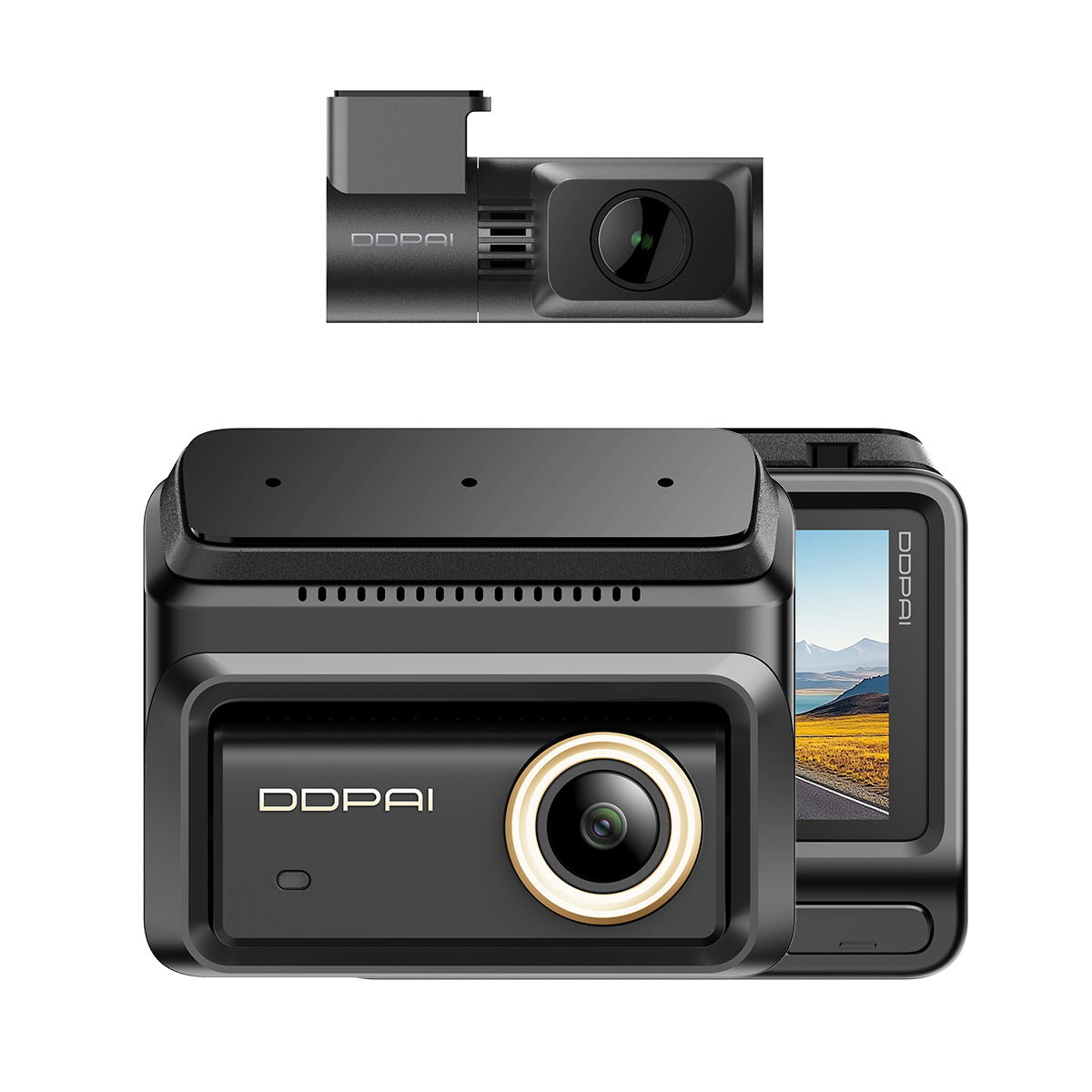
The DDPAI Z90 Pro 2CH is a dual dash-cam system with 4K front and 2K rear recording, a Sony STARVIS 2 sensor, and 64GB of built-in backup storage. It suits drivers who want detailed evidence, fast phone transfers, and storage redundancy without stepping up to a three-camera kit.
At a Glance#
Product : DDPAI Z90 Pro 2CH 4K Front + 2K Rear Dash Cam
Brand : DDPAI
Best For : Daily commuters, road-trip drivers, and two-car households that want front-and-rear evidence with storage redundancy
Form Factor : Black two-channel windshield dash cam with separate rear camera, 3-inch IPS display, and adhesive mounts
Exact Variant : Z90 Pro 2CH standard kit, without the optional interior camera, hardwire kit, or 4G module
Buy Now : View on Amazon
Key Highlights:
- 4K front recording gives the main camera more detail for signs, vehicles, and incident context
- 2K rear coverage records more useful detail than the 1080p rear cameras bundled with many dual-channel systems
- 64GB eMMC storage provides an internal recording layer alongside an optional microSD card
- 5GHz Wi-Fi Turbo shortens the wait when previewing or downloading large video clips to your phone
- Supercapacitor construction is better suited to temperature swings than a conventional lithium battery
Who Should Buy This#
The DDPAI Z90 Pro 2CH sits in the useful middle ground between simple front-only cameras and elaborate three-channel systems. You get high-resolution coverage in both driving directions, built-in storage, GPS data, and a screen. You do not have to mount a camera inside the cabin or manage its extra wiring.
That balance makes sense for drivers who care more about clear road evidence than cabin footage. Budget dual-camera kits often reserve their best sensor for the front and drop the rear feed to basic 1080p. The Z90 Pro keeps the front camera at 4K while raising the rear to 2K, which is a more credible setup for identifying what approached or struck your vehicle from behind.
Perfect for:
- Long-distance commuters who spend hours in traffic and want both front and rear context when an incident has conflicting accounts
- Summer road-trippers who need dependable loop recording, quick clip retrieval, and a supercapacitor for hot parked cars
- New-car owners who want discreet evidence coverage without committing to the cost and installation work of a three-channel system
- Families with multiple drivers who benefit from a built-in screen, voice capture, and storage that does not depend on one removable card
The standard 2CH package is the key detail. DDPAI also sells hardwired, 4G, and three-channel versions under the Z90 Pro name. This review covers the Amazon listing for the black two-channel front-and-rear kit. Check current availability for that exact configuration: View on Amazon
Design & Build Quality#
The Z90 Pro uses a compact horizontal main camera with an integrated 3-inch IPS display. The lens sits on the front section, while the screen faces the driver for setup and local playback. At 83 x 67.5 x 46.3mm, the body is small enough to sit high behind most rear-view mirrors, though it is not as invisible as a screenless barrel camera.
That display is worthwhile during installation. You can confirm the horizon, check whether the hood fills too much of the frame, and verify the rear camera angle without relying entirely on a phone. Physical buttons also make basic operation possible when pairing an app would be inconvenient.
The separate rear module is much smaller and mounts near the top of the rear glass. DDPAI includes a 6m extension cable, which should cover most sedans, hatchbacks, and compact SUVs when routed around the headliner. Large three-row SUVs and vehicles with opening tailgates require more careful cable planning. Leave enough slack near a hatch hinge so repeated opening does not pull on the connector.
Both cameras use adhesive mounting rather than suction cups. Adhesive mounts stay compact and resist vibration, but placement deserves a dry run. Use the included electrostatic sticker where appropriate, preview both views, and only then press the mounts firmly into place. The standard kit also includes a trim tool, car charger, 3.5m power cable, rear extension cable, and user guide.
DDPAI builds the camera around a supercapacitor instead of a rechargeable lithium battery. A supercapacitor only holds enough energy to finish and save a recording after external power is interrupted. It is not designed for cordless operation. The advantage is thermal tolerance and long-term reliability in a windshield environment that can become extremely hot in summer.
Key Features#
4K Front Recording With STARVIS 2#
The front camera records 3840 x 2160 video at 30 frames per second using Sony's 1/1.8-inch, 8-megapixel STARVIS 2 IMX678 sensor. That resolution contains four times as many pixels as 1080p. The extra detail gives you more room to inspect road signs, vehicle shape, lane position, and nearby plates after an incident.
Resolution alone does not guarantee a readable plate. Motion, distance, windshield reflections, rain, and headlight glare all affect the result. DDPAI pairs the sensor with HDR and its NightVIS 2.0 processing to balance bright and dark areas. The practical goal is to preserve detail when a reflective plate or headlamp sits against a dark road.
The front camera also offers 2880 x 1620 recording at 60fps. This mode trades some spatial detail for twice the frame rate. The smoother capture can help with fast cross-traffic or highway motion, while 4K30 remains the stronger choice when maximum frame detail matters. Drivers can choose based on route and priorities instead of being locked to one mode.
The 135-degree front field of view is broad without chasing an extreme fisheye look. It covers several lanes and useful roadside context while keeping objects reasonably large in the frame. Very wide 160- or 170-degree cameras see farther toward the doors, but they spread the same pixels across more scenery and can make distant plates smaller.
2K Rear Coverage That Is More Than an Afterthought#
The rear camera records 2560 x 1440 video at 30fps. That is about 78% more pixels than 1920 x 1080. For a rear feed, the increase matters because the camera often shoots through tinted glass, defroster lines, weather, and the longer distance behind the vehicle.
Its 126-degree view concentrates detail on the road behind rather than stretching aggressively toward both rear pillars. This framing suits collision evidence: it captures the following lane, adjacent traffic, and a vehicle approaching from behind without shrinking everything into a very wide scene.
Rear-camera quality still depends heavily on installation. Mount the lens inside the swept area of the rear wiper when possible. Avoid placing it directly on a defroster line, and clean the glass on both sides before final alignment. In a hatchback, route the cable through the flexible factory boot if access is straightforward. Loose cable across the hinge area can snag or fatigue over time.
Front-and-rear synchronization adds context that a single camera cannot. The front view can establish your speed, lane, and traffic signal while the rear view shows whether another driver was following closely. That paired timeline is often more useful than a dramatic but incomplete front clip.
Dual Storage With 64GB eMMC#
Storage redundancy is the Z90 Pro's most distinctive practical feature. The camera includes 64GB of eMMC storage and accepts a U3-rated microSD card up to 512GB. The internal memory means the system is not entirely dependent on one removable card that can wear out, become corrupted, or be left on a desk after footage review.
Dash cams continuously overwrite old clips, so storage media sees far more write cycles than a phone or camera card. A high-endurance microSD card is still the right companion. Capacity determines how much history you retain before loop recording overwrites the oldest unprotected files. Larger cards are useful for dual-channel recording because two high-resolution streams consume space simultaneously.
The built-in memory is not a reason to ignore card health. Review the app's storage status periodically, format the card through the camera when recommended, and confirm that both channels are saving playable files. After any important event, lock or export the clip promptly rather than assuming loop recording will preserve it indefinitely.
This dual-storage approach reduces a common single point of failure. It is particularly valuable for family cars, where nobody may notice that a card was removed or reached the end of its useful life. Storage cannot prevent every recording failure, but two available media layers are more reassuring than one.
Faster Clip Access Through 5GHz Wi-Fi#
High-resolution evidence is only useful if you can retrieve it without friction. The Z90 Pro uses 5GHz Wi-Fi Turbo and Bluetooth Low Energy 5.1 for pairing and local transfer through the DDPAI app. The 5GHz connection offers more bandwidth than older 2.4GHz dash-cam links, which matters when a short dual-channel incident can occupy hundreds of megabytes.
The connection is local; the standard 2CH kit does not include cellular service. You connect your phone while near the vehicle to preview, play, download, and share recordings. Remote live view, geofencing, cloud alerts, and two-way calls require DDPAI's optional 4G hardware and compatible service. Those features should not be assumed from the base Amazon package.
The built-in screen provides a useful fallback. You can verify that a clip exists or adjust framing even when your phone is unavailable. For detailed review, exporting the original file to a larger display remains better than judging plate detail on a 3-inch panel.
Voice control can save a photo and a ten-second clip when you say “Take Photo.” DDPAI records five seconds before and five seconds after the command. This is useful for road hazards or unusual events when reaching for a button would be unsafe. Voice capture supplements automatic impact locking; it does not replace careful driving or later verification.
GPS, ADAS Alerts, and Parking Options#
Built-in multi-system positioning supports GPS, BDS, GLONASS, Galileo, and QZSS. The camera can associate time, route, location, and speed data with a trip for review in the DDPAI app. That context can help reconstruct where an incident happened and how the vehicle was moving.
Location and speed overlays can also reveal personal travel patterns. Drivers who share clips publicly should export or edit with privacy in mind. Check the app settings before deciding which telemetry should appear in saved or shared footage.
ADAS 2.0 includes forward-vehicle-start and driver-fatigue alerts. These are convenience prompts, not substitutes for factory driver-assistance systems. Windshield camera position, road markings, and calibration affect warning quality. If repeated alerts become distracting, tune or disable them rather than allowing a nonessential feature to pull attention away from the road.
The Z90 Pro supports parking surveillance, including time-lapse and impact-triggered recording, but the standard kit cannot run those modes after the ignition outlet shuts off. Continuous parking protection requires a compatible DDPAI hardwire kit. Installation connects to the fuse box and should include a sensible low-voltage cutoff to protect the starter battery.
Hardwiring is optional and adds complexity. Drivers who only need journey recording can use the supplied car charger and avoid touching the fuse panel. Drivers who park on the street or in shared garages gain more value from professional hardwire installation, especially when front-and-rear monitoring is the primary reason for buying.
Installation and Daily Use#
Plan the complete cable route before removing any adhesive backing. Position the main camera high on the passenger side of the mirror where the lens has a clear view and the driver can still reach the controls. Confirm that local laws permit the chosen windshield location and that the camera does not obstruct the driver's view.
Route the power lead along the headliner, down a pillar, and toward the vehicle outlet. Never push a cable across the deployment path of a curtain airbag. Keep it behind the trim in a location approved for accessory wiring, or ask a professional installer when the airbag route is unclear.
The rear cable requires the most time. Test the full run from the front camera to the rear window, accounting for trim corners and hatch movement. Connect both cameras before final mounting, power the system, and verify front and rear previews. A level horizon and modest view of the car body provide helpful orientation without wasting too much of the frame.
After installation, set the date, time zone, clip length, G-sensor sensitivity, and preferred front resolution. Excessive G-sensor sensitivity can lock ordinary bumps and fill protected storage. Too little sensitivity may miss lighter parking impacts. Start near the middle and adjust after several normal drives.
Create a simple monthly check: play a recent front clip, play its matching rear clip, inspect the lenses, and review storage health. This takes minutes and catches dirt, a shifted mount, or a failing card before the day you need evidence. Dash cams reward routine verification more than feature collecting.
For a two-channel system with built-in backup storage and a screen, the exact Z90 Pro 2CH package is the sensible starting point. View the current Amazon listing here: View on Amazon
Technical Specifications#
Exact Model and Variant : DDPAI Z90 Pro 2CH standard front-and-rear kit, black
Front Video : 3840 x 2160 at 30fps, or 2880 x 1620 at 60fps
Rear Video : 2560 x 1440 at 30fps
Front Sensor : Sony STARVIS 2 IMX678, 1/1.8-inch, 8 megapixels
Field of View : 135 degrees front and 126 degrees rear
Aperture : f/1.75 front and f/2.0 rear
Display : 3-inch IPS screen, 640 x 360 pixels
Internal Storage : 64GB eMMC built into the main camera
Expandable Storage : MicroSD up to 512GB; U3-rated high-endurance card recommended
Wireless Connectivity : 5GHz Wi-Fi Turbo and Bluetooth Low Energy 5.1
Positioning : GPS, BDS, GLONASS, Galileo, and QZSS support
Impact Detection : 3-axis G-sensor with emergency clip protection
Power System : USB Type-C external power with internal supercapacitor
Operating Temperature : -4°F to 158°F (-20°C to 70°C)
Main Camera Dimensions : 3.27 x 2.66 x 1.82 in (83 x 67.5 x 46.3mm)
Included Rear Cable : 6m extension cable for the rear camera
Amazon ASIN : B0G3WCZD1G
Pros & Cons#
Pros:
- Detailed coverage in both directions: 4K front and 2K rear recording avoids treating the rear view as a low-resolution extra
- Storage redundancy: 64GB eMMC provides an internal layer alongside an optional high-endurance microSD card
- Strong front sensor foundation: Sony's STARVIS 2 IMX678 combines an 8-megapixel 1/1.8-inch sensor with HDR processing
- Useful resolution choice: Drivers can select 4K30 for detail or 3K60 for smoother high-speed motion
- Faster local retrieval: 5GHz Wi-Fi reduces friction when moving large incident clips to a phone
- Heat-conscious power design: A supercapacitor suits hot windshields better than a conventional rechargeable battery
- Complete standard kit: The box includes front and rear cameras, long cables, car power, adhesive mounting supplies, and a trim tool
Cons:
- Parking recording costs extra: The standard Amazon package needs a separate compatible hardwire kit for monitoring with the ignition off
- No cabin camera in this variant: Rideshare drivers need the distinct three-channel package rather than assuming every Z90 Pro includes interior coverage
- No remote connection out of the box: 4G live view, alerts, and cloud functions require optional hardware and service
- Installation takes planning: Routing a 6m rear cable around trim and away from airbags is more involved than fitting a front-only camera
- Screen adds visible bulk: The 3-inch display aids setup but makes the main unit less discreet than a screenless dash cam
Final Verdict#
Buy it. The DDPAI Z90 Pro 2CH is a well-targeted dual dash cam for drivers who prioritize front-and-rear detail, fast evidence retrieval, and storage redundancy over cabin recording or bundled cellular features.
Its best argument is not one headline specification. It is the combination of 4K front capture, a genuinely useful 2K rear feed, 64GB of built-in eMMC, expandable storage, and a heat-tolerant supercapacitor. Those features address the practical ways dash cams fail: weak rear footage, slow access, worn cards, and harsh windshield temperatures.
Our recommendation: Choose the exact standard 2CH kit if you mainly need driving evidence. Add a high-endurance U3 microSD card, and budget for professional hardwiring only if parking surveillance matters. Confirm the front-and-rear variant on Amazon: View on Amazon