
At a Glance#
The five decisions : How the blade is made and what it weighs, how hard the steel is, how thick the blade is behind the edge, the handle in a wet hand, and the upkeep you will genuinely keep up with
The one most people get wrong : Chasing the hardest steel for the longest-lasting edge, then discovering it chips on a bone and needs gear they don't own to sharpen
The spec that matters instead : Steel hardness measured in HRC — it silently sets edge retention, toughness, and how much sharpening kit the knife will demand of you
The quiet dealbreaker : Buying a knife that must be hand-washed and dried when you know you will put it in the dishwasher
Key Highlights:
- Forged blades carry more heft; stamped blades are lighter and cheaper, and neither is "better" in the abstract
- Harder steel holds its edge longer but is more brittle and harder to sharpen; softer steel is tougher and easier to maintain
- What a buyer actually feels is the thickness behind the edge, not the edge angle
- A handle that grips when wet is a safety feature, not a luxury
- Only one of these three is dishwasher-rated, and even it lasts longer hand-washed
Who This Is For#
A chef's knife handles the large majority of cutting tasks in a kitchen, so it is the one tool worth matching carefully to how you actually cook. The specifications that decide satisfaction — hardness, heft, blade geometry, and upkeep — are also the ones that get glossed over in favour of a photogenic Damascus pattern or a low price.
Especially useful if you are:
- A first-time buyer who wants a clear framework instead of scrolling through hundreds of look-alike listings
- A budget-minded cook who needs a sharp, reliable workhorse without spending premium-knife money
- An enthusiast upgrading your edge who wants thinner, harder steel and is willing to hand-wash and hone with care
- Anyone buying a gift who needs to know which knife rewards careful handling and which forgives rough treatment
The three knives here were chosen because they resolve these decisions in genuinely different directions: a German all-rounder, a stamped value workhorse, and a Japanese precision blade. All three are 8-inch chef's knives, the most versatile length for a home board.
1. Forged or Stamped, and What Weight Buys You#
The first fork is how the blade is made, because it sets both the heft in your hand and the price on the shelf.
A forged blade is shaped from a single piece of steel, usually with a full bolster and a full tang running the length of the handle. The Wüsthof Classic is forged in Solingen, Germany, from high-carbon stainless steel with exactly that construction, and it weighs roughly 240 g. That mass is not padding: it is what makes rocking cuts feel effortless and gives the knife authority through a butternut squash. The full bolster also acts as a finger guard and a balance point.
A stamped blade is cut from a sheet of steel like a cookie from dough, then ground and finished. The Victorinox Fibrox Pro is stamped and lands at around 180 g — noticeably lighter than the forged Wüsthof. Many cooks prefer that lightness for speed and reduced hand fatigue during big batch prep, and stamping is a large part of why the knife costs a fraction of a forged one. The trade is that a thinner stamped blade flexes more and carries less heft for heavy tasks.
Blade length folds into this same decision rather than standing on its own. All three knives here are 8 inches, which is long enough to slice a large vegetable or a roast yet short enough to control on a home board. A 6-inch blade feels nimbler for small hands or a tiny kitchen; a 10-inch covers more in a stroke if you cook in volume. But length changes far less about how a knife feels day to day than whether it is a dense forged tool or a light stamped one.
Our recommendation: if you want authority and a knife that feels substantial, buy forged and accept the weight and the price. If you want speed, low fatigue, and low cost, buy stamped and accept the lighter, more flexible blade.
2. Steel Hardness Is the Trade Nobody Explains#
Hardness is the single specification that quietly determines how a knife behaves, and it is measured on the Rockwell scale in HRC. It is a genuine trade with two ends, not a "higher is better" number.
Harder steel holds a keen edge longer, so you sharpen it less often, and it can be ground thinner for finer cutting. The cost is brittleness: a harder edge is more prone to chipping if you twist it through a bone or scrape it sideways across a board, and it is more demanding to sharpen when the time comes. The Shun Classic sits at roughly 60–61 HRC, with a hard VG-MAX cutting core clad in 32 layers of Damascus-style steel. That hardness is its headline feature — the steel keeps its edge far longer than a softer German knife — and its handling requirement is the flip side of the same coin.
Softer steel is tougher and easier to maintain. It forgives the occasional bone-knock or board-scrape that would chip a harder edge, and it comes back to sharp with basic gear. The Wüsthof Classic runs at approximately 58 HRC, which is exactly why it is so beginner-friendly. The Victorinox Fibrox Pro sits a little lower, around 55–56 HRC, which keeps it easy to bring back to a working edge.
None of these is "the best" hardness. A harder blade asks for good technique and careful handling in exchange for a longer-lasting edge; a softer blade absorbs mistakes and is quick to maintain.
Our recommendation: if you have solid board habits and want the longest edge life, buy hard — the Shun's 60–61 HRC. If you are still building technique or want a knife that shrugs off abuse, buy softer — the Wüsthof at ~58 HRC or the Victorinox at ~55–56.
3. How the Blade Actually Cuts#
Once hardness is settled, cutting feel comes down to the shape of the steel behind the edge — spine thickness and taper — far more than to the edge angle everyone quotes.
A blade with a thin spine that tapers to almost nothing slides through dense produce rather than wedging it apart. The Victorinox is about 2 mm at the spine and tapers to nearly zero, which is why it glides through a sweet potato with little resistance. The Shun pairs its hard steel with a thin profile, so it parts a tomato or an onion with almost no pressure. The Wüsthof carries a slightly thicker spine, and that extra material behind the edge is part of what lets it survive a bone-knock that would chip a harder, thinner blade — the same heft that makes it forgiving also makes it feel like it is doing more work through a dense vegetable.
This is the real resolution of the "German versus Japanese" question: it is decided by hardness and blade thickness, not by edge angle. All three knives here are ground within a narrow band of roughly 14–16 degrees per side, and the difference a buyer actually feels at the board is the thickness of steel behind the edge, not those one or two degrees.
Our recommendation: if effortless glide through dense produce is your priority, buy a thin blade — the Shun's hard, thin profile or the Victorinox's thin taper. If you want a blade that feels robust and forgives a knock, the Wüsthof's slightly thicker spine is the trade you want.
4. The Handle, and What Happens When Your Hands Are Wet#
A knife is only as safe as its grip when your hands are wet or greasy, which in a real kitchen is most of the time.
The Victorinox uses a textured Fibrox thermoplastic handle that grips tighter when wet — the opposite of a smooth or polished handle that becomes slippery. It also carries an NSF certification for commercial kitchens, and its shape sits naturally in a pinch grip through a long prep session. This is the most forgiving handle here for wet-hand work.
The Wüsthof uses a triple-riveted synthetic POM handle, ergonomic and durable, paired with a full bolster that keeps your fingers from sliding forward onto the blade. It is a traditional, substantial feel that suits the knife's heft.
The Shun fits a slim, light D-shaped PakkaWood handle that tucks comfortably into a pinch grip for fine work. It is elegant and precise, but it is a wood-composite shape built for control rather than for the maximum wet-hand security of a textured synthetic grip.
Our recommendation: if slippery hands are a daily reality, buy the textured synthetic grip — the Victorinox Fibrox. If you want a traditional substantial handle with a finger-guarding bolster, the Wüsthof suits; if fine-work control matters most, the Shun's slim D-shape is built for it.
5. The Upkeep You Will Actually Do#
The last decision is the most honest one: not what a knife needs in theory, but what you will actually do. Two purchase-relevant facts settle it — the sharpening gear the steel demands, and the way you will wash it.
Sharpening gear tracks hardness. A softer blade like the Victorinox at ~55–56 HRC or the Wüsthof at ~58 comes back to a working edge with a basic honing steel or a whetstone — no specialised kit. A harder blade like the Shun at ~60–61 HRC rewards a finer touch: a fine ceramic rod or a whetstone rather than a basic steel. Buying a hard knife means buying, and being willing to use, the gear that suits it.
Washing is the quieter dealbreaker. Of these three, only the Victorinox is rated dishwasher-safe — and even then, hand washing extends its edge life. The Wüsthof, and especially the Shun, should always be hand-washed and dried; dishwasher heat, detergent, and jostling are hard on a fine edge. So the purchase question is simple: if you know you will not hand-wash a knife, do not buy one that requires it. Match the knife to the habit you actually have, not the one you intend to adopt.
Sharpening kit and a hand-washing routine are also worth remembering because a chef's knife is not the only prep tool that needs the right upkeep habit — a microplane zester review and a Fullstar vegetable chopper review cover two others that live alongside it on the counter.
Our recommendation: if you will hand-wash and are happy to keep a ceramic rod or whetstone, a hard blade like the Shun is yours to maintain. If you want dishwasher tolerance and basic-tool sharpening, the Victorinox is the honest match.
Three Knives, Three Different Answers#
None of these is better in the abstract; each resolves the five decisions in a different direction.
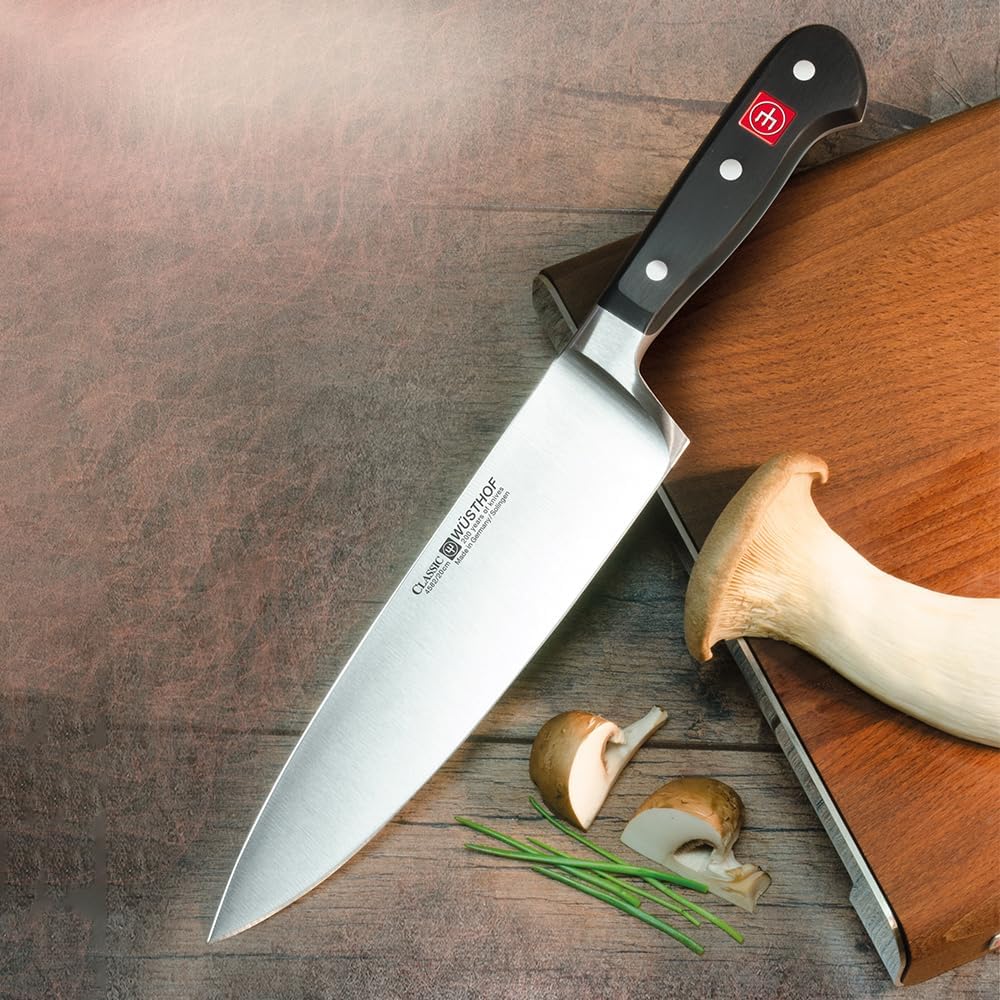
The Wüsthof Classic 8-inch is the German-workhorse answer: forged, roughly 240 g, ~58 HRC, with a slightly thicker spine and a full bolster. It is the do-everything blade that forgives a bone-knock and comes back to sharp with basic gear — the safest "buy once" choice for a cook who wants quality without overthinking it: View on Amazon
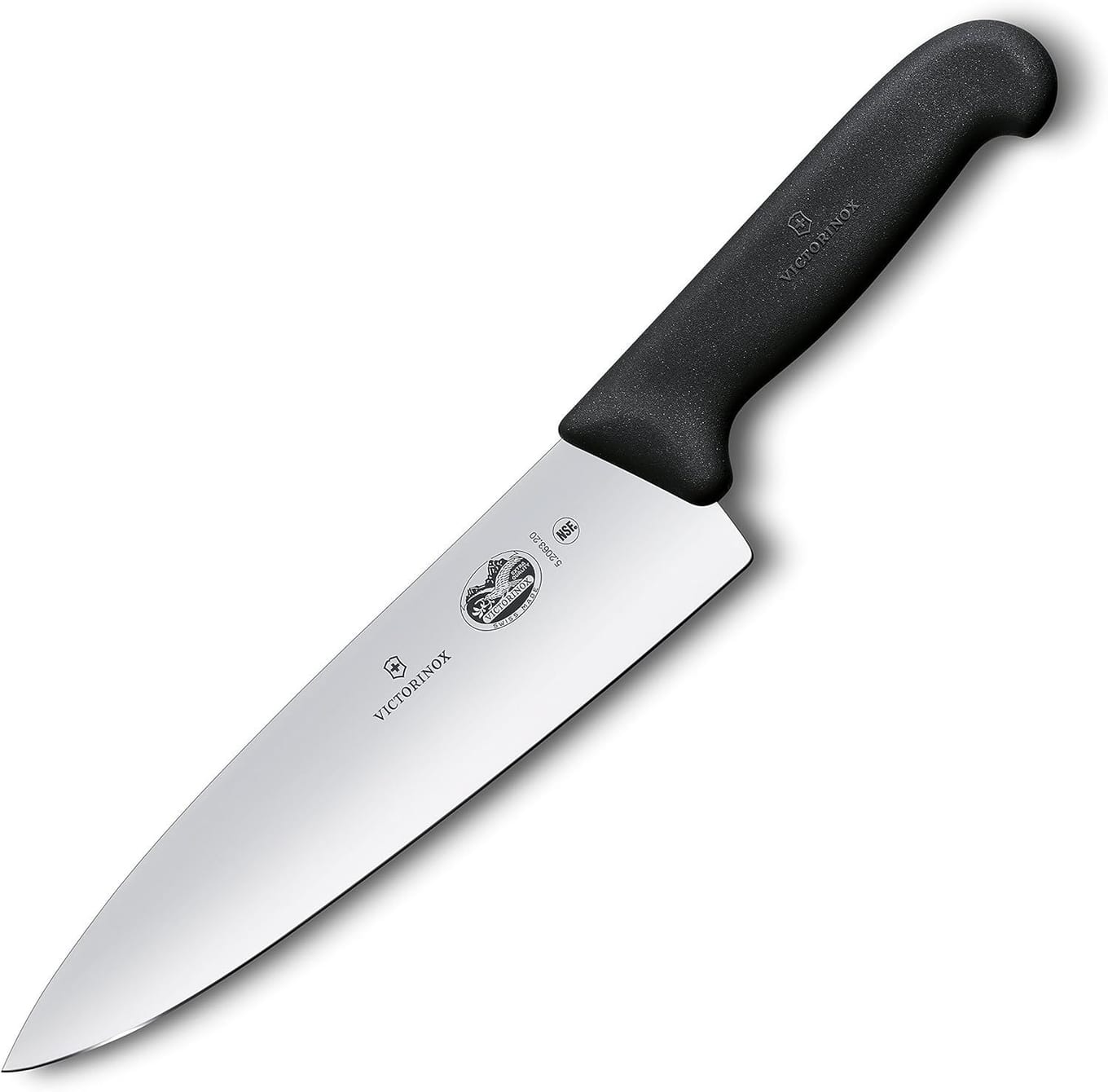
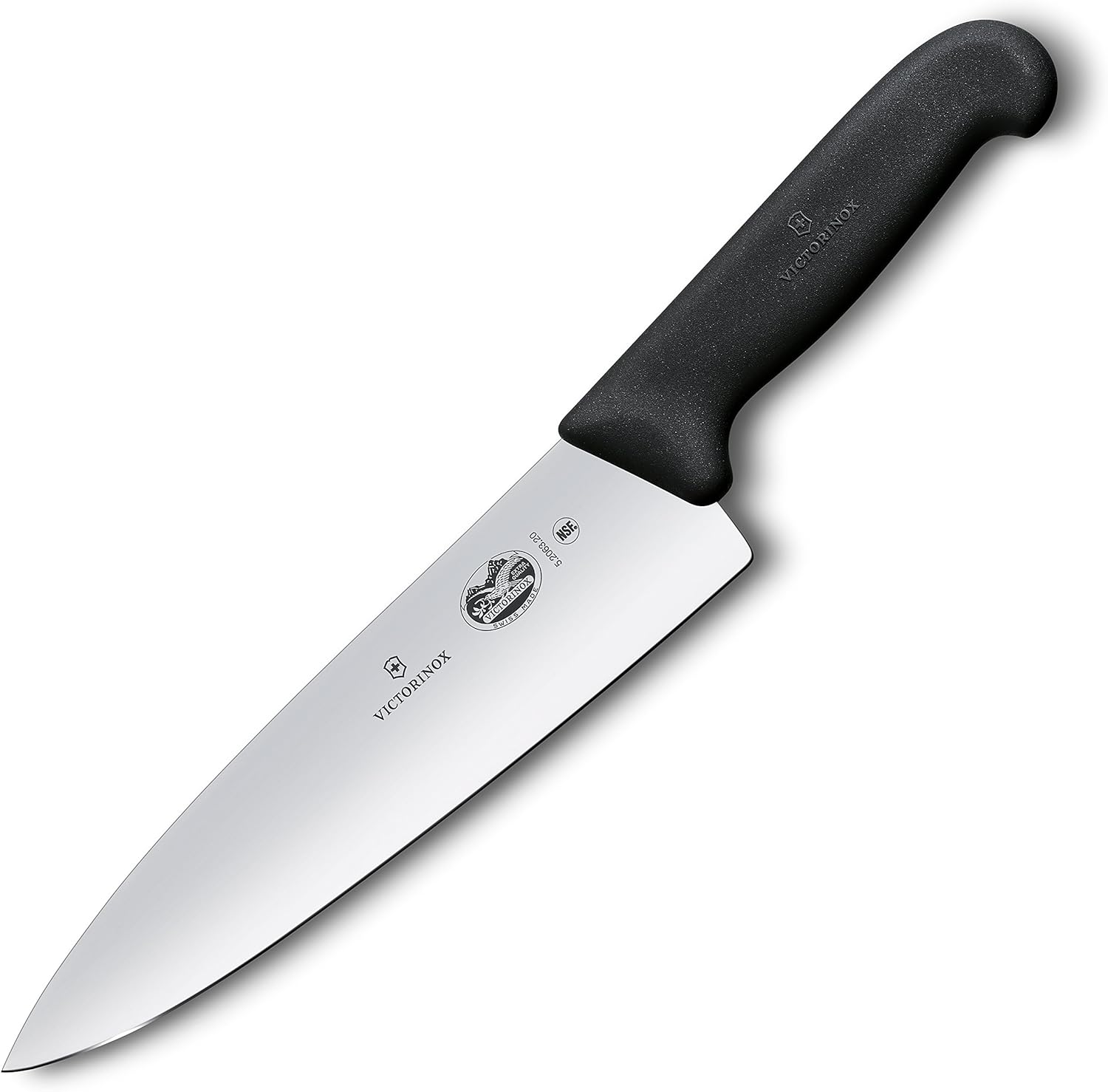
The Victorinox Fibrox Pro 8-inch is the value-stainless answer: stamped, around 180 g, ~55–56 HRC, with a thin taper, an NSF-certified grip that holds when wet, and the only dishwasher rating in the group. It delivers most of a premium knife's cutting performance for a fraction of the price: View on Amazon
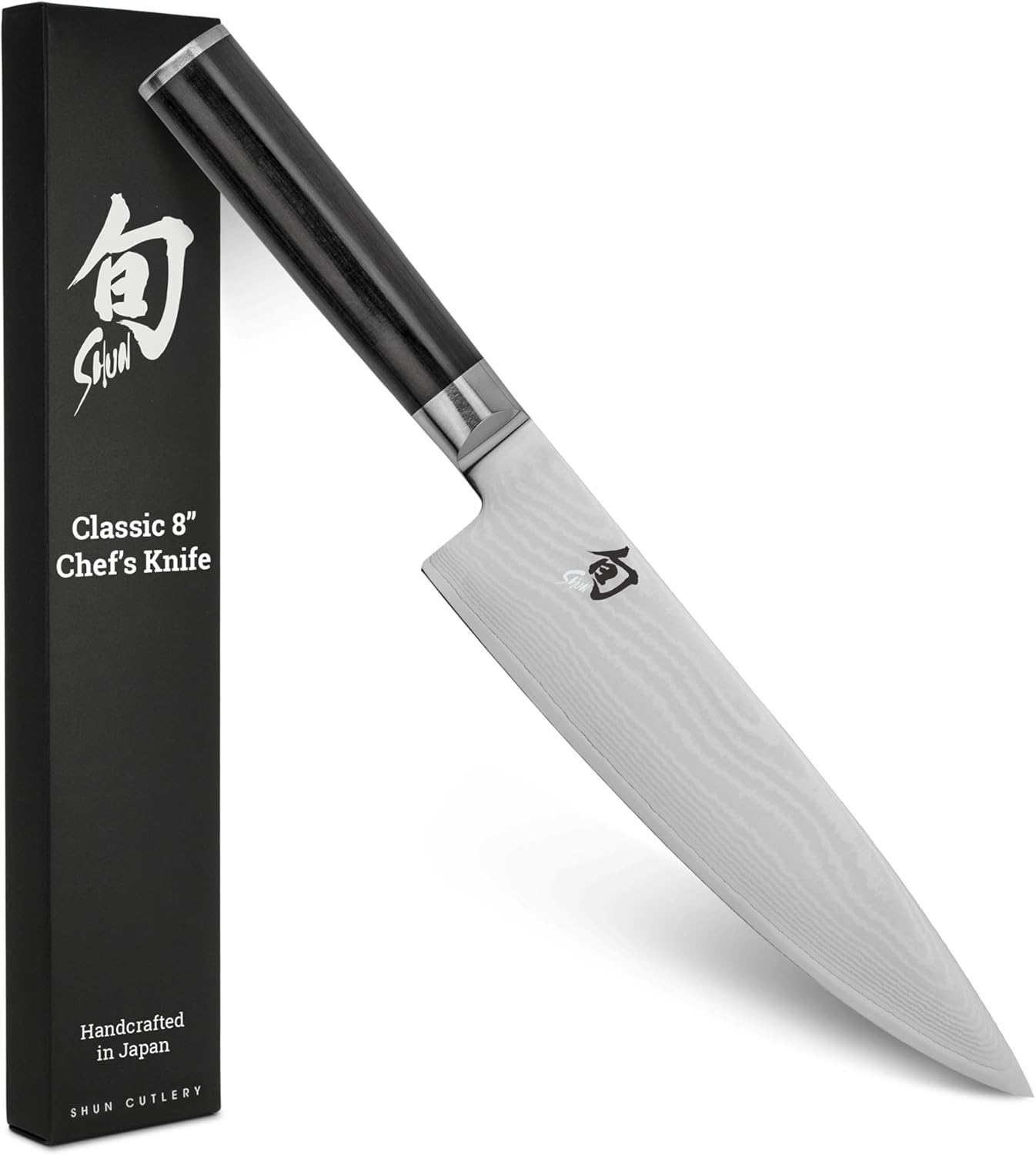
The Shun Classic 8-inch is the Japanese answer: a hard VG-MAX core at ~60–61 HRC, thin and Damascus-clad, on a slim D-shaped handle. It holds a keen edge the longest and slices with the least effort, provided you hand-wash it, avoid bones, and keep a ceramic rod or whetstone: View on Amazon
How to Choose in Five Minutes#
Start with make and weight. If you want a substantial forged tool, look at the Wüsthof; if you want a light, low-cost stamped blade, look at the Victorinox.
Then decide how hard. Longest edge life and finest cutting point to the Shun at ~60–61 HRC; forgiving toughness and easy sharpening point to the softer Wüsthof or Victorinox.
Then picture the cut. A thin blade that glides through dense produce is the Shun or the Victorinox; a robust spine that survives a knock is the Wüsthof — and remember the feel comes from thickness behind the edge, not the edge angle.
Then check the handle against your hands. Wet and greasy most of the time means the textured Victorinox Fibrox: View on Amazon
Finally, be honest about upkeep. If you will hand-wash and keep the right stone, a hard knife rewards you. If the knife will meet a dishwasher, buy the one rated for it and sharpened with basic tools — and if you are unsure, the Victorinox is the low-risk place to learn what you actually prefer before adding a Wüsthof or a Shun.