

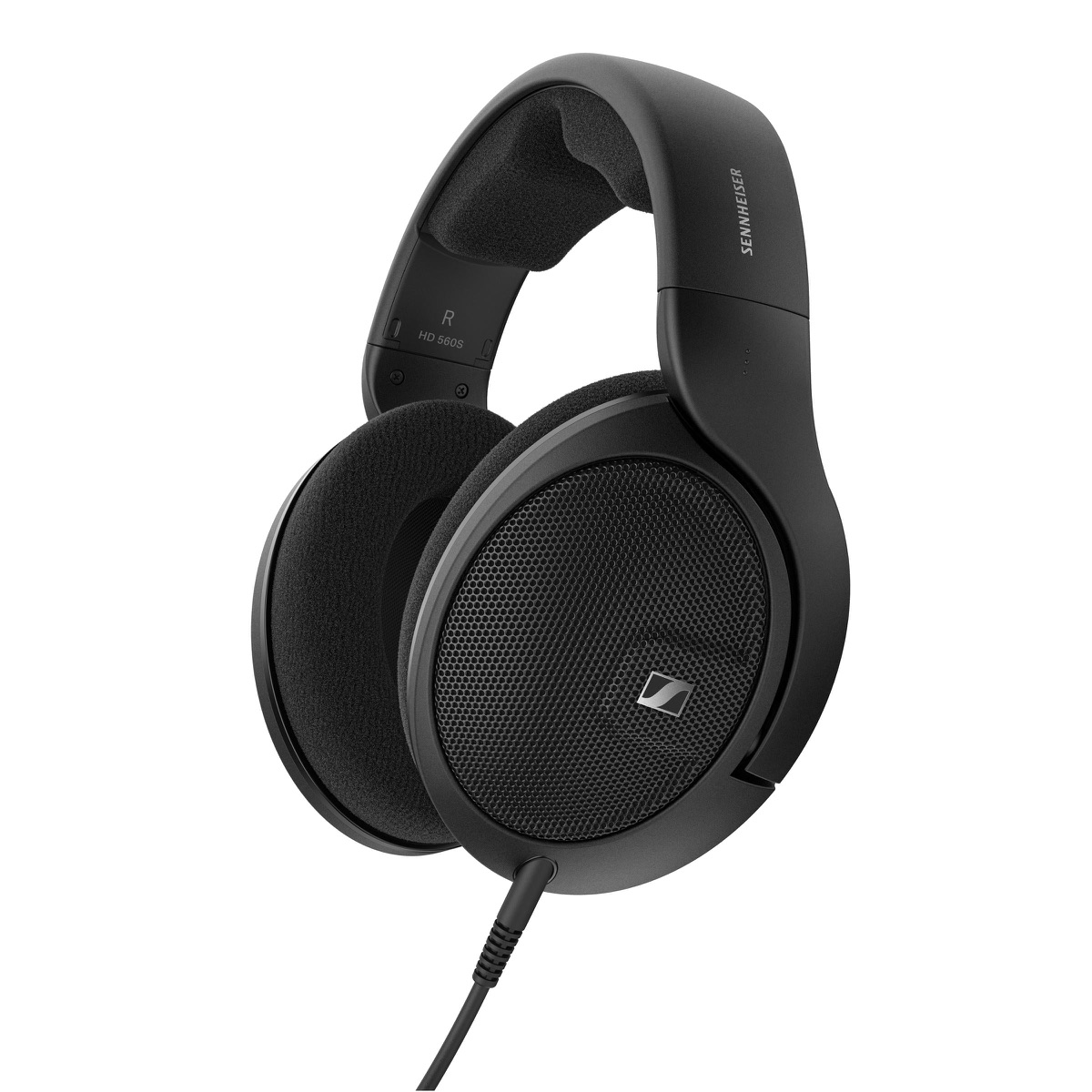
At a Glance#
Product : Sennheiser HD 560S
Brand : Sennheiser
Best For : Audiophiles, home producers, and mixing engineers who want flat reference response on a tight budget
Form Factor : Open-back, circumaural (over-ear), wired with detachable 1.8m cable
Buy Now : View on Amazon
Key Highlights:
- Reference-tuned neutral response reveals mix flaws other headphones hide
- 120-ohm drivers run loud and clean from a phone, no amp required for casual listening
- Oval velour earpads contour to the ear for fatigue-free listening sessions
- Open-back design produces wide, speaker-like soundstage with natural imaging
- Detachable cable with 3.5mm plug plus screw-on 6.3mm adapter included
Who Should Buy This#
The HD 560S hits a sweet spot for listeners who want studio-grade neutrality without stepping up to the HD 600 series. Sennheiser tuned this pair flat, and its own claim for the low end is "deep bass extension that reveals what nearfield loudspeakers often struggle to reproduce — especially between 20 and 50 Hz", with the spec table putting the frequency response at 6 Hz - 38,000 Hz. Mids stay forward and uncoloured, treble is detailed without sibilance.
Perfect for:
- Home producers and bedroom mixers who need an honest reference to spot muddy low-mids and harsh highs before exporting
- Audiophiles upgrading from gaming or consumer headsets who want to hear what reference actually sounds like
- Office workers and writers who do 6-8 hour listening days and need lightweight, non-fatiguing comfort
- Classical, jazz, and acoustic listeners who value soundstage width and instrument separation over thumping bass
Recognise yourself in that list? Check the current price: View on Amazon
Design & Build Quality#
The HD 560S keeps Sennheiser's familiar mid-range plastic chassis — same shell family as the HD 5XX series — finished in matte black with subtle silver accents on the earcup grilles. Sennheiser lists it at 280 g. That is unremarkable for an open-back over-ear rather than notably light — Sennheiser's own HD 599 and HD 660S2 are listed at 250 g and 260 g — but the plastic chassis keeps it off the heavy end, and the trade-off is that the construction won't survive being thrown in a backpack unprotected. The headband padding is generous and the clamping force is moderate — firm enough to stay put, loose enough to forget you're wearing them.
The oval velour earpads are the standout. They're shaped to follow the ear's natural geometry rather than circling it tightly, which keeps your lobes from rubbing against the inner baffle. The pads are user-replaceable when they wear out (a common complaint with sealed-pad headphones in this range). The detachable 1.8m cable terminates in a 3.5mm plug, with a screw-on 6.3mm adapter in the box.
Key Features#
Reference-Neutral Tuning#
The HD 560S targets a reference curve — no bass boost, no V-shape, no hyped treble. Sennheiser's own description of the transducer is "an all-new 120 ohm transducer, featuring a specialized polymer blend in its diaphragm for linear excursion and improved brilliance above 10 kHz", and the level down low stays flat with the mids rather than overpowering them. This is what mastering engineers and reviewers mean when they say "honest" headphones. You hear the recording, not the headphone's signature.
If you're coming from Beats, Sony XM5, or any consumer can, the HD 560S will sound thin or boring at first. Give it a week. You'll start noticing room reverb tails, vocal sibilance, and bass-guitar fingering noise you never knew was on the recording. Once you adjust, going back to colored headphones feels like wearing tinted sunglasses indoors.
120-Ohm Drivers — No Amp Required#
Most reference headphones in this tier need a desktop amp. The HD 600 is 300-ohm. The DT 880 ships in 250-ohm and 600-ohm versions. Both struggle off a phone or laptop. The HD 560S is 120-ohm, which sits in a friendlier zone — it gets loud enough on a MacBook Pro headphone jack, an iPhone with a USB-C dongle, or a budget DAC like the Apple dongle or FiiO KA1.
That said, it scales with better amplification. Pair it with a desktop amp/DAC (JDS Atom, Schiit Magni, FiiO K7) and you get tighter bass control and a wider soundstage. The takeaway: it's amp-friendly without being amp-dependent.
Open-Back Soundstage#
Open-back means the rear of the driver vents to the air rather than into a sealed cup. This trades isolation for soundstage. Music sounds like it's around you rather than between your ears — closer to listening to studio monitors than headphones. Stereo separation is wide, instruments occupy distinct positions, and large orchestral or live recordings breathe.
The trade-off: zero isolation. Your roommate hears what you're listening to, and you hear them. Don't buy these for the train or a shared open-plan office. They're a home and quiet-room headphone.
All-Day Comfort#
At Sennheiser's stated 280 g, with velour pads and moderate clamp, the HD 560S sits comfortably rather than lightly. Velour breathes in a way leather pads do not, which is what keeps long sessions comfortable. The headband distributes weight evenly so there's no hot-spot on the crown. This is the difference between a headphone you tolerate and one you forget you're wearing.
Glasses wearers — the velour pads are forgiving here. The pad surface doesn't grip the temples like leather pads do, so frame pressure is minimal.
Detachable Cable, User-Serviceable#
The cable connects via a proprietary 2.5mm twist-lock connector at the left cup. Replacement cables are available from Sennheiser and from third-party sellers in longer lengths or balanced terminations. The included 1.8m cable is a desk-friendly length — early production shipped a longer 3m studio cable with a 6.3mm plug instead.
The earpads pop off with a quarter-twist, and replacements are readily available. This matters for longevity — most headphones in this class become unusable when the pads disintegrate after 2-3 years.
Technical Specifications#
Transducer Principle : Dynamic, open
Acoustic Principle : Open-back, circumaural
Impedance : 120 ohms
Frequency Response : 6 Hz - 38,000 Hz
Sensitivity (SPL) : 110 dB at 1 kHz / 1 Vrms
Total Harmonic Distortion (THD) : Sennheiser's storefront spec table leaves this row blank, but its launch press release gives "an extraordinarily low THD (<0.05% at 90 dB)"
Weight : 280 g on Sennheiser's spec table. Treat it as approximate: the same template gives 250 g for the HD 599 and 260 g for the HD 660S2, both higher tiers
Cable : 1.8 m detachable, twist-lock connector
Connector : 3.5 mm plug + screw-on 6.3 mm (1/4") adapter
Earpad Material : Oval velour, replaceable
In the Box : Headphones, 1.80 m cable with 3.5 mm plug, screw-on 3.5-to-6.3 mm jack adapter, drawstring storage bag
Warranty : Sennheiser's own listing reads "Includes 2-year manufacturer warranty"
Pros & Cons#
Pros:
- Reference-flat tuning with no bass hump or hyped treble
- 120 ohm impedance runs cleanly from phones, dongles and laptops without a desktop amp
- Frequency response of 6 Hz - 38,000 Hz, with bass Sennheiser highlights "especially between 20 and 50 Hz"
- 110 dB SPL at 1 kHz, 1 Vrms
- Oval velour pads breathe where leather pads do not, and are user-replaceable
- Detachable 1.80 m cable, with a screw-on 3.5-to-6.3 mm adapter in the box
- Open-back staging puts instruments in distinct positions rather than between your ears
Cons:
- Open-back leaks sound in both directions - useless for an office, transit or a shared room
- All-plastic chassis, at 280 g, feels less premium than metal-framed rivals
- Proprietary twist-lock cable connector limits cheap third-party swaps
- Neutral tuning sounds thin at first to anyone coming from bass-heavy consumer headphones
- Only a drawstring storage bag in the box - no hard case
Final Verdict#
Buy it. The HD 560S delivers genuine reference sound in a segment where most competitors are still bass-boosted consumer fare. Sennheiser's own line is "an all-new 120 ohm transducer, featuring a specialized polymer blend in its diaphragm for linear excursion and improved brilliance above 10 kHz", the spec table gives 6 Hz - 38,000 Hz at 110 dB (1 kHz, 1 Vrms), and 120 ohms means it runs off a phone dongle. It is open-back, so it leaks in both directions - a home and quiet-room headphone only.
Our recommendation: Pair it with a USB-C DAC like the FiiO KA1 or Apple dongle for clean output from a phone or laptop. You'll get 90% of the experience of a full desktop-amp setup. Pick one up: View on Amazon