

For home workouts, WHATAFIT is the best overall — stackable tube bands with handles reach 300 lbs. Fit Simplify loop bands are the best budget pick for glutes and mobility. TheraBand flat bands are best for physical therapy and gentle rehab.
Resistance bands are the most space-efficient way to build strength at home. A full set weighs less than a dumbbell, stores in a drawer, and travels in a carry-on. But "resistance bands" covers three very different tools: tube bands with handles for heavy pressing and rowing, flat loop bands for lower-body activation, and flat therapy bands for rehab. Buying the wrong type is the most common mistake. Below we match each of the three best sets to the job it actually does well.
Bands also have a quiet advantage over dumbbells that most buyers overlook: variable resistance. A band gets harder as it stretches, which means the load peaks exactly where your muscle is strongest — the top of a curl or the lockout of a press. That builds strength through the full range of motion and is famously joint-friendly, because the tension eases off in the stretched, vulnerable position rather than yanking on it. Add in silent operation, a footprint the size of a lunchbox, and a price a fraction of an equivalent weight set, and it is easy to see why bands have become the default home-fitness tool. The only real decision left is which type fits your goal.
Who this comparison is for#
- Home exercisers without weights who want a full strength routine that stores in a drawer and costs less than a single dumbbell.
- Renters and travelers who need compact, quiet, apartment-friendly gear with no drilling, no dropped iron, and no noise complaints.
- People rehabbing an injury or easing back into fitness who need light, precisely controllable resistance rather than heavy tension.
How we picked#
We did not chase the set with the most pieces or the flashiest chart. We picked the set that best serves each type of buyer, judged against the criteria below. A rehab patient and a strength-focused home lifter need opposite tools, so a single "best band set" would be misleading — the honest answer is three, one per job.
- Resistance range that matches the job: we checked whether each set delivers enough tension for its intended user, from a few pounds for rehab up to 300 lbs stacked for strength training.
- Durability signals: we favored sets with anti-snap construction, layered latex, and reinforced clip or seam points, since band failure is both the top complaint and a safety issue.
- Complete kit vs. deliberate simplicity: some users need handles, a door anchor, and ankle straps; others only want three clean loops. We rated each set against what its buyer actually uses.
- Review depth: every pick has thousands to tens of thousands of ratings averaging 4 stars or better, so quality is proven at scale, not promised.
- Price spread: we deliberately span budget to premium so there is a right answer whether you want to spend the price of a coffee or the price of one dumbbell.
Product 1 — WHATAFIT Heavy Resistance Bands Set (Best Overall)#
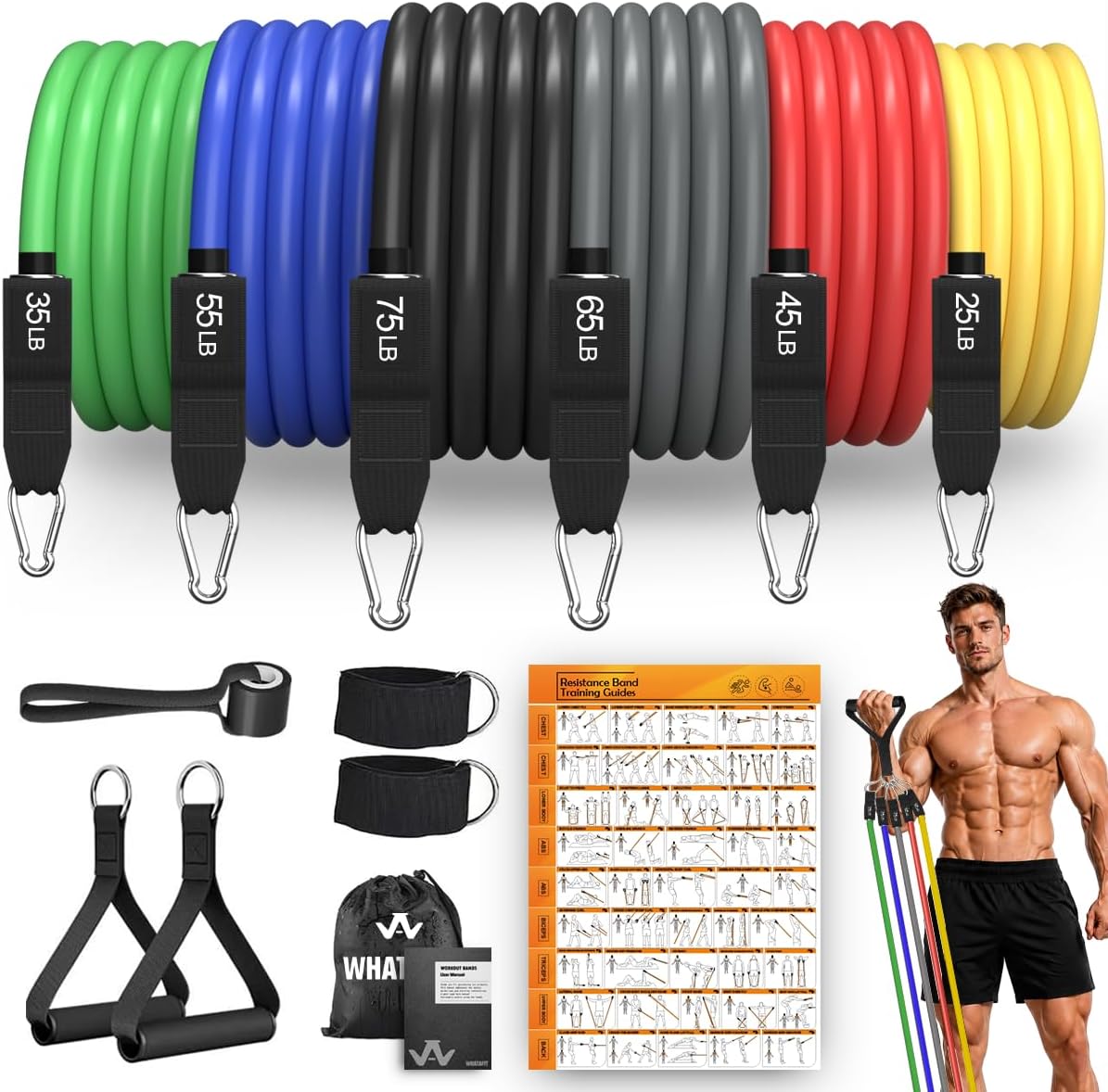
The WHATAFIT set is the closest thing to a portable home gym in a drawstring bag. You get five color-coded tube bands rated from 25 lbs up to 75 lbs, plus foam handles, two ankle straps, a door anchor, and a carry bag. Because the bands clip together, you can stack all five for up to roughly 300 lbs of combined tension — enough to make chest presses, rows, squats, and deadlifts genuinely challenging.
What makes this the all-rounder pick is the handle-and-anchor system. Handles let you replicate cable-machine movements like bicep curls, triceps pushdowns, and seated rows with a natural grip. The door anchor turns any interior door into an attachment point for lat pulldowns and face pulls, so you are not limited to floor exercises. That versatility is exactly what a home exerciser without weights needs.
The five graded bands are the other half of the appeal. Instead of one fixed resistance, you get a spread from a light 25 lb band suitable for shoulders and warm-ups up to a stout 75 lb band for legs and back. Beginners can start light and build confidence without straining; stronger users can stack bands for compound lifts. That single-purchase range means one person can use the set for rehab-adjacent light work while another in the same household loads it heavy — a flexibility a fixed pair of dumbbells simply cannot offer.
The tubes use layered latex with a nylon-lined sleeve that reduces the chance of a sudden snap and contains the band if it ever does fail. It is not indestructible — clip-on tube systems are inherently more failure-prone than a single molded loop — but at this tension range and price, the build is reassuring. Setup takes seconds and the whole kit packs down smaller than a shoebox.
Progression is where a stackable set earns its keep. On day one you might curl with a single 25 lb band; three months later you clip on a second band and the same movement gets harder without buying anything new. A realistic full-body session looks like door-anchored rows, floor presses, banded squats, standing curls, and overhead presses — roughly 30 minutes covering every major muscle group with no rack, no bench, and no dropped iron on a downstairs neighbor's ceiling. For anyone building a home routine from scratch, that combination of range, versatility, and quiet operation is hard to beat.
Key Specs#
Band type : Clip-on tube bands with foam handles
Number of bands : 5 color-coded (25 / 35 / 45 / 55 / 75 lbs)
Max combined tension : Up to ~300 lbs stacked
Included accessories : 2 foam handles, 2 ankle straps, door anchor, carry bag, exercise guide
Best use : Full-body strength, presses, rows, curls
Portability : Packs into included drawstring bag
Bottom line#
If you want one set that covers your whole body and can grow with your strength, buy this one.
Check current availability: View on Amazon
Product 2 — Fit Simplify Resistance Loop Bands, Set of 5 (Best Budget)#
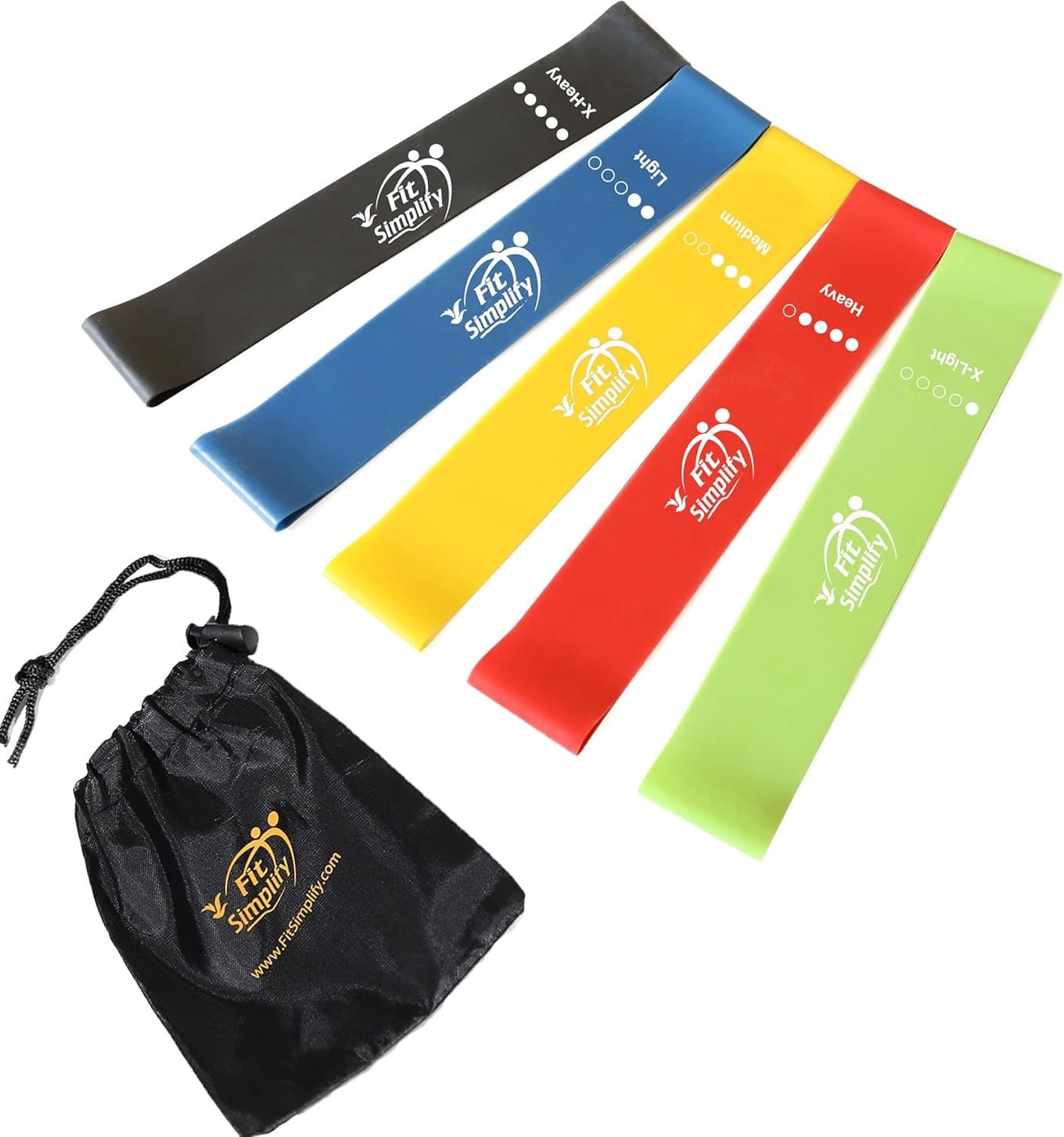
The Fit Simplify loop set is one of the best-selling resistance products on Amazon for a reason: it does one job extremely well for the price of a takeout lunch. You get five continuous flat loops in graded strengths from extra-light to extra-heavy, plus a small carry pouch and an instruction guide. There are no handles, no clips, and nothing to break.
That simplicity is the point. Continuous molded loops have no clip or seam to fail, so they outlast tube sets under normal use. They shine for lower-body activation — glute bridges, lateral band walks, clamshells, and hip abductions — and for warm-ups before heavier training. Physical therapists hand these out constantly because they are foolproof and gentle to start.
The trade-off is ceiling. Even the extra-heavy loop tops out far below what the WHATAFIT tubes reach, and without handles you cannot easily load pressing movements. But for glute and hip work, mobility, and travel, this is all most people need. At this price you can toss a set in every bag you own and never think about it again.
They also pair beautifully with heavier gear. Runners loop a light band above the knees for activation drills before a run; lifters use them to fire up the glutes before squats; desk workers run through a five-minute hip and shoulder routine to undo a day of sitting. Because the resistance is graded, you can progress from the extra-light band to the extra-heavy one as you get stronger, or use a lighter band on high-rep burnout sets. For a set that costs less than a movie ticket, the range of legitimate uses is remarkable.
Key Specs#
Band type : Continuous flat loop bands
Number of bands : 5 (X-Light, Light, Medium, Heavy, X-Heavy)
Max tension : Roughly 30 lbs on the heaviest loop
Included accessories : Carry pouch, instruction guide
Best use : Glutes, hips, mobility, warm-ups, travel
Portability : Fits in a pocket
Bottom line#
If you want the cheapest set that just works for lower-body and mobility training, this is it.
Grab a set here: View on Amazon
Product 3 — THERABAND Professional Resistance Bands (Best for Physical Therapy and Rehab)#
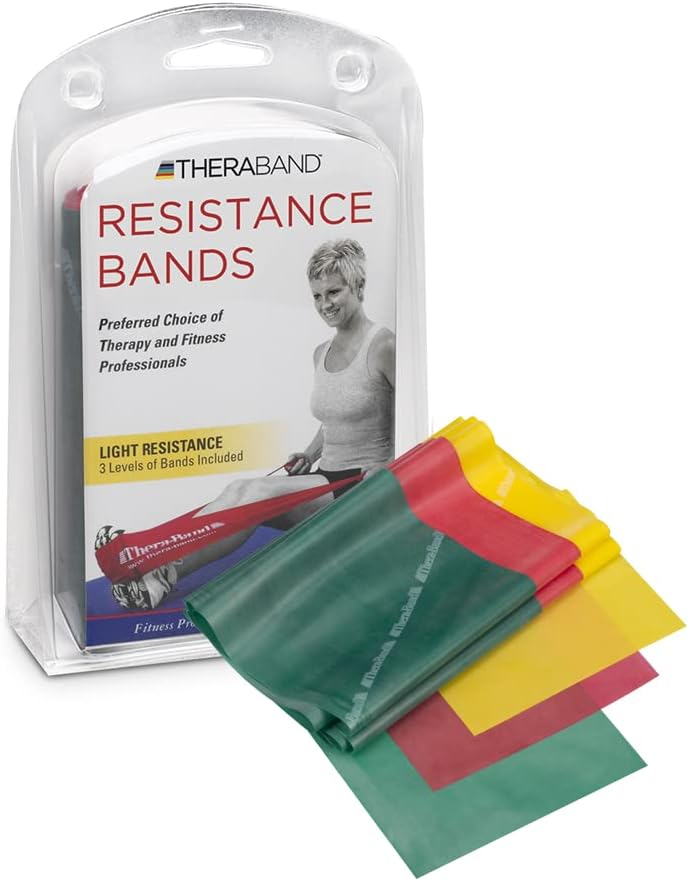
TheraBand is the clinical standard. Walk into almost any physical therapy clinic and these color-coded flat bands are what you will be handed. The beginner set includes three progressive resistance levels — yellow, red, and green — in the exact same graded system therapists use to prescribe and track rehab progress.
The difference from the other two picks is control. Flat therapy bands let you apply very light, smooth, evenly distributed resistance that is ideal for shoulder rehab, knee stability work, ankle strengthening, and post-injury reconditioning. You cut the length you want, so you can fine-tune tension in a way loops and fixed tubes cannot match. For gentle, progressive loading, nothing beats them.
These are not for maxing out your bench press. The tension is deliberately modest, and the flat latex will wear faster than a molded loop if you abuse it. But for their intended job — rehab, mobility, Pilates, and easing back into movement without risking a flare-up — they are the most trusted bands you can buy. If you are recovering from an injury or new to training, start here and graduate to the WHATAFIT set later.
The color-coded system is the quiet genius here. Because yellow, red, and green map to defined, repeatable resistance levels, you can follow a therapist's program precisely and know exactly when you have progressed from one level to the next. That objectivity matters during recovery, when overdoing it sets you back and under-doing it wastes weeks. Common uses include rotator-cuff external rotations for shoulder rehab, seated knee extensions after surgery, ankle dorsiflexion for sprains, and gentle scapular retractions to counter rounded posture. None of that requires much force — it requires control, and control is exactly what flat therapy bands deliver.
Key Specs#
Band type : Flat professional therapy bands (cut-to-length)
Number of bands : 3 progressive levels (Yellow, Red, Green)
Resistance : Light and precisely controllable
Included accessories : Resealable retail pack, exercise instructions
Best use : Physical therapy, rehab, Pilates, mobility
Portability : Flat and featherweight, folds into a pocket
Bottom line#
If you are rehabbing an injury or need gentle, controllable resistance, these are the bands the professionals actually use.
Check current availability: View on Amazon
Which one should you buy?#
If you want one set to build real strength across your whole body, pick the WHATAFIT set. The handles, door anchor, and stackable tubes let you train presses, rows, curls, and lower body with enough tension to keep progressing for months. It is the best default choice for most home exercisers.
If you are on a budget or mostly want lower-body and mobility work, pick the Fit Simplify loops. They cost a fraction of the others, never break under normal use, and are unbeatable for glute activation, warm-ups, and travel. Many people happily own these plus one other set.
If you are recovering from an injury, managing a joint issue, or brand new to exercise, pick the TheraBand professional bands. The light, precisely graded resistance is designed for safe, progressive loading, and it is the same system your physical therapist would prescribe.
Still torn? Buy the Fit Simplify loops alongside whichever primary set fits you. At their price, they add lower-body and warm-up capability to any kit for almost nothing.
A quick word on longevity, since it applies to all three. Latex bands last for years when treated well and fail fast when abused. Keep them out of direct sun and away from heaters, since UV and heat degrade latex. Never stretch a band past roughly two-and-a-half times its resting length. Inspect for small nicks or cloudy stress marks before each session — a tiny tear is where a snap starts. Wipe off sweat and let them dry before storing. Follow those habits and even the budget loops will outlast several gym memberships, while the tube set's clips stay tight and safe.
FAQ#
Which resistance band set is best for building muscle at home?#
The WHATAFIT set is the best for building muscle because its stackable tube bands reach up to roughly 300 lbs and include handles and a door anchor. That lets you load pressing and pulling movements with enough tension to drive real strength gains, which flat loop or therapy bands cannot match.
Are cheap resistance bands like Fit Simplify actually any good?#
Yes. Continuous flat loop bands have no clips or seams to fail, so inexpensive sets like Fit Simplify are extremely durable and effective for lower-body and mobility training. Their only real limitation is a lower maximum tension, which matters for heavy pressing but not for glute, hip, or warm-up work.
What is the difference between tube bands and flat therapy bands?#
Tube bands are round, clip to handles, and deliver higher tension for strength training. Flat therapy bands like TheraBand are wide, cut to length, and deliver light, smoothly controllable resistance ideal for rehab and physical therapy. Tube bands build muscle; flat bands restore and protect it.
Which resistance bands do physical therapists recommend?#
Physical therapists most commonly use TheraBand professional bands. Their color-coded, progressive resistance system is the clinical standard for prescribing and tracking rehab exercises, which is why these bands appear in nearly every PT clinic.
Do resistance bands break easily, and how do I make them last?#
Quality bands rarely break under normal use. To extend their life, avoid overstretching beyond about 2.5 times their resting length, keep them away from direct sunlight and heat, inspect for nicks before each use, and wipe them clean of sweat. Tube-and-clip sets need more inspection than one-piece molded loops.
Can resistance bands replace free weights entirely?#
For most home fitness goals, yes. A stackable set like WHATAFIT provides enough progressive tension for full-body strength and hypertrophy. Serious powerlifters chasing very heavy one-rep maxes will still want a barbell, but for general strength, toning, and conditioning at home, bands are a complete solution.