For beginner home baristas, the Breville Barista Express is our best overall — its built-in grinder makes real espresso approachable from day one. The De'Longhi Stilosa is the best budget entry, and the Gaggia Classic Evo Pro is best for anyone who wants room to grow into the craft.
Who this comparison is for#
- First-time espresso buyers who want café-style shots at home but feel overwhelmed by the gear, jargon, and price tags.
- Kitchen counter realists who need a machine that fits a normal countertop and won't demand a plumbing hookup or a second mortgage.
- Aspiring baristas who plan to learn the craft — dialing in grind, timing shots, and steaming milk — rather than just pressing a pod button.
How we picked#
- Semi-automatic, not pods. Every pick uses a portafilter and gives you control over the shot. Capsule and super-automatic machines are a different category entirely.
- Beginner-friendly workflow. We favored machines that are forgiving to learn on, with clear controls and a reasonable path from first shot to good shot.
- Steam wand included. All three froth milk for lattes and cappuccinos, since most beginners want more than straight espresso.
- Proven reliability. Each model has thousands of reviews and a long track record — no unproven newcomers with thin support.
- A real price ladder. One splurge all-in-one, one genuine budget entry, and one mid-priced machine you can upgrade over years.
Product 1 — Breville Barista Express BES870XL (Best Overall)#
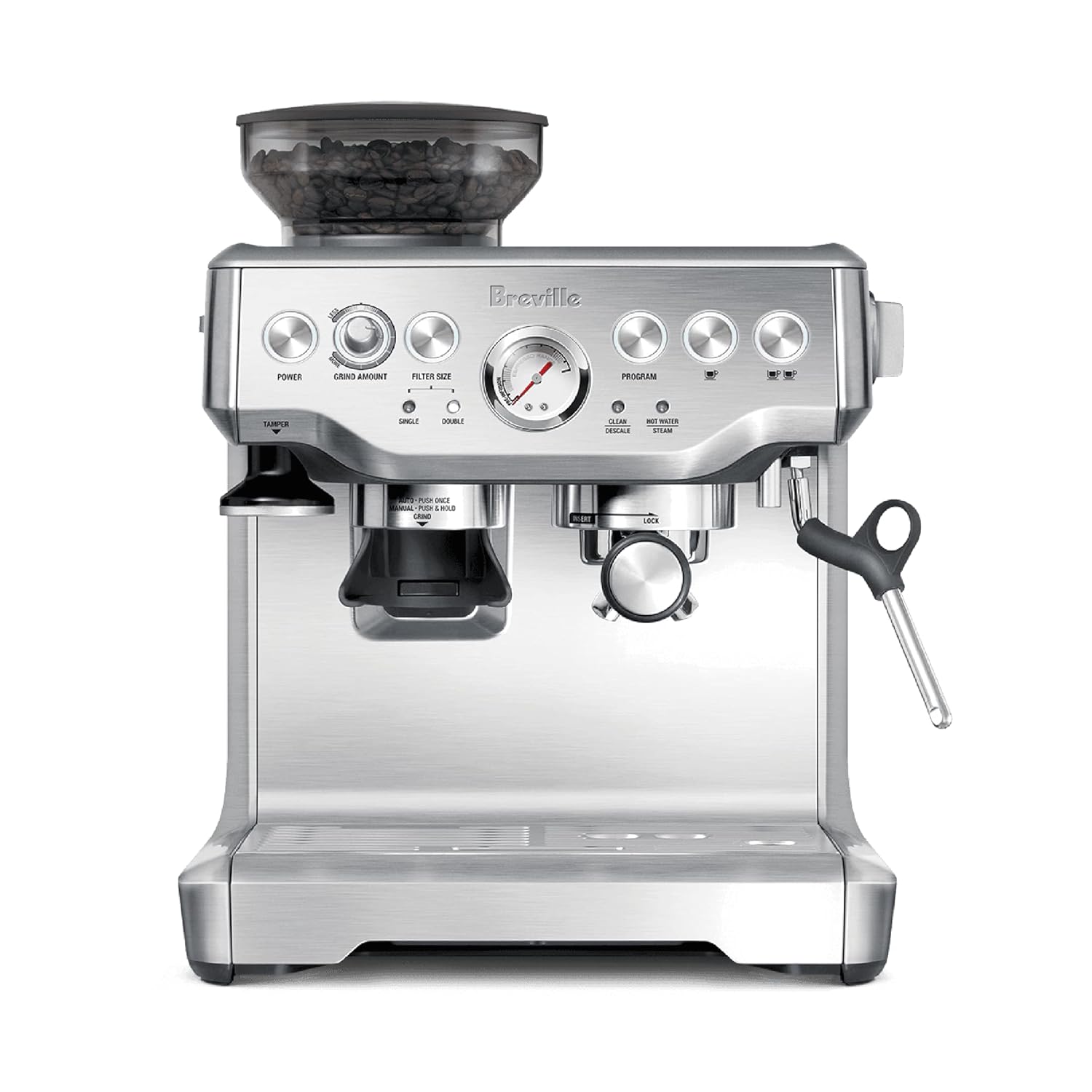
The Breville Barista Express is the machine that turned a generation of kitchen-counter curious into actual home baristas. It bundles a conical burr grinder, a 15-bar pump, digital temperature control, and a steam wand into one stainless-steel box — so you go from whole beans to a finished latte without buying a separate grinder first.
That integrated grinder is the reason it tops this list for beginners. Fresh grounds are the single biggest factor in good espresso, and the Barista Express grinds directly into the portafilter on demand. You dial grind size with one knob and dose amount with another, then tamp and pull. It removes the most common beginner mistake — brewing with stale, pre-ground coffee — before you can make it.
It is not a point-and-forget machine, and that is the point. You will spend your first week learning to dial in the grind so shots run in the 25-30 second range. Once it clicks, the Barista Express produces espresso that genuinely rivals a neighborhood café, and the built-in PID keeps water temperature stable shot after shot.
Key Specs#
Type : Semi-automatic with integrated conical burr grinder
Pump Pressure : 15-bar Italian pump with low-pressure pre-infusion
Temperature Control : Digital PID for consistent brew temperature
Portafilter : 54mm, with single-wall and dual-wall baskets
Water Tank : 67 oz (2L) removable reservoir
Milk : Manual steam wand plus hot-water outlet for Americanos
Footprint : Roughly 12.5 x 13.25 x 15.75 in — plan counter space for the bean hopper up top
Bottom line#
The most complete beginner package on the market: it is the only pick here that grinds its own beans, so it is the fastest route from unboxing to a real espresso habit.
Product 2 — De'Longhi Stilosa EC260BK (Best Budget)#
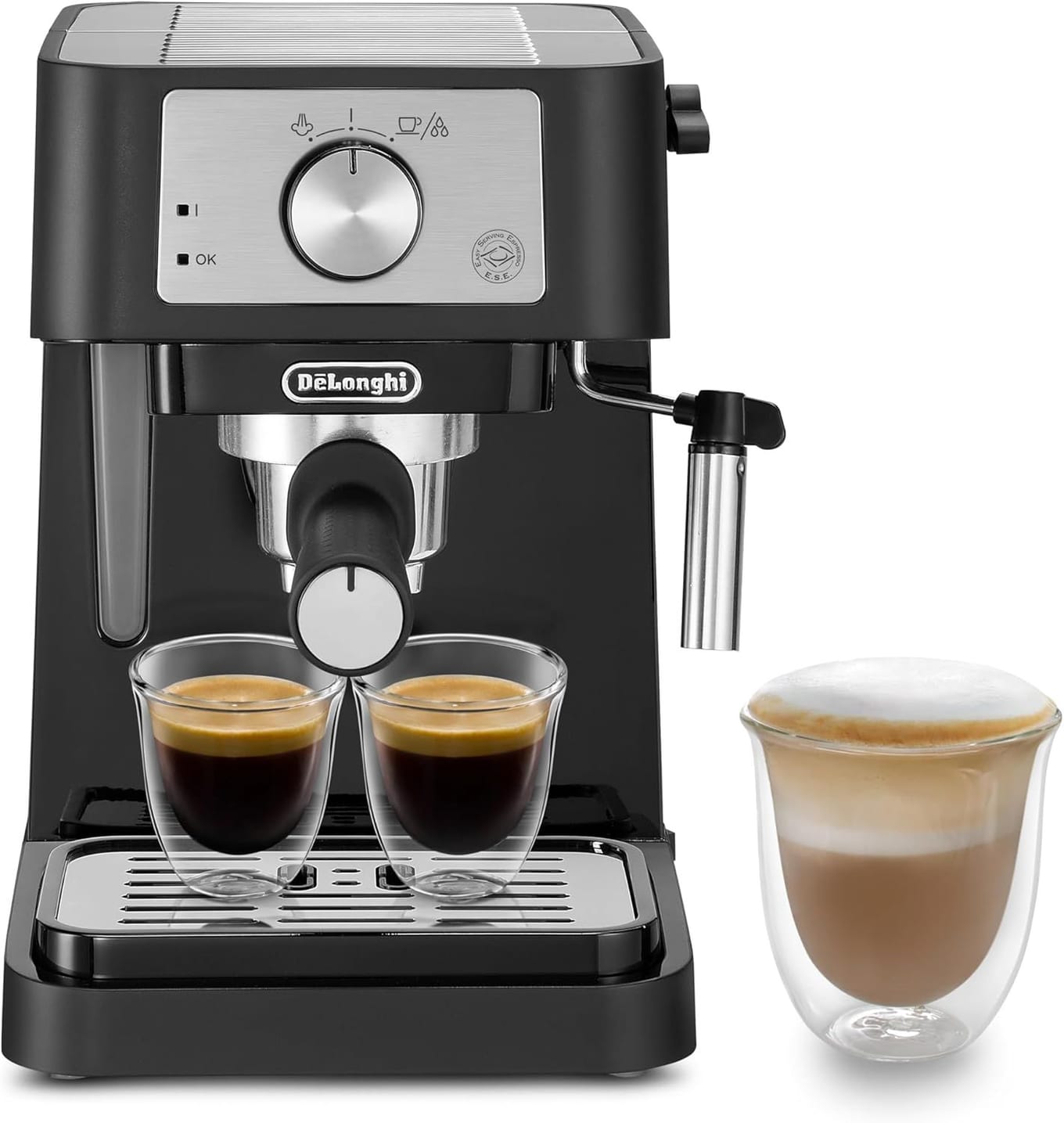
The De'Longhi Stilosa is the cheapest honest way to find out whether espresso is a hobby you actually want. It costs a small fraction of the Breville, takes up barely any counter, and still uses a real 15-bar pump and a proper portafilter — not a pod system dressed up to look like one.
You give up the grinder and the digital temperature control, and that is the trade. There is no PID, so the boiler cycles rather than holding a precise temperature, and you will need a separate grinder or bags of pre-ground coffee to feed it. For someone testing the waters, that is a reasonable compromise for the price.
What surprises people is how capable the fundamentals are. The pressurized baskets are forgiving of an imperfect grind, so early shots come out with crema even before your technique is dialed. The manual steam wand froths enough milk for a cappuccino, and the whole machine is light and simple to clean. If you outgrow it, you are out very little money.
If you go this route, pair it with a decent grinder — fresh grounds matter more than the machine. Our best manual coffee grinders for home baristas roundup covers affordable options that punch above their price.
Key Specs#
Type : Manual semi-automatic, no built-in grinder
Pump Pressure : 15-bar pump
Temperature Control : Standard stainless-steel boiler, no PID
Portafilter : Pressurized baskets for single and double shots, tamper included
Water Tank : Roughly 1L removable reservoir
Milk : Manual milk-frother steam wand
Footprint : One of the most compact machines here — fits tight countertops easily
Bottom line#
The lowest-risk entry point to espresso: a real pump machine for pocket-money money, ideal if you are not yet sure the hobby will stick.
Product 3 — Gaggia Classic Evo Pro (Best for the Upgrade Path)#
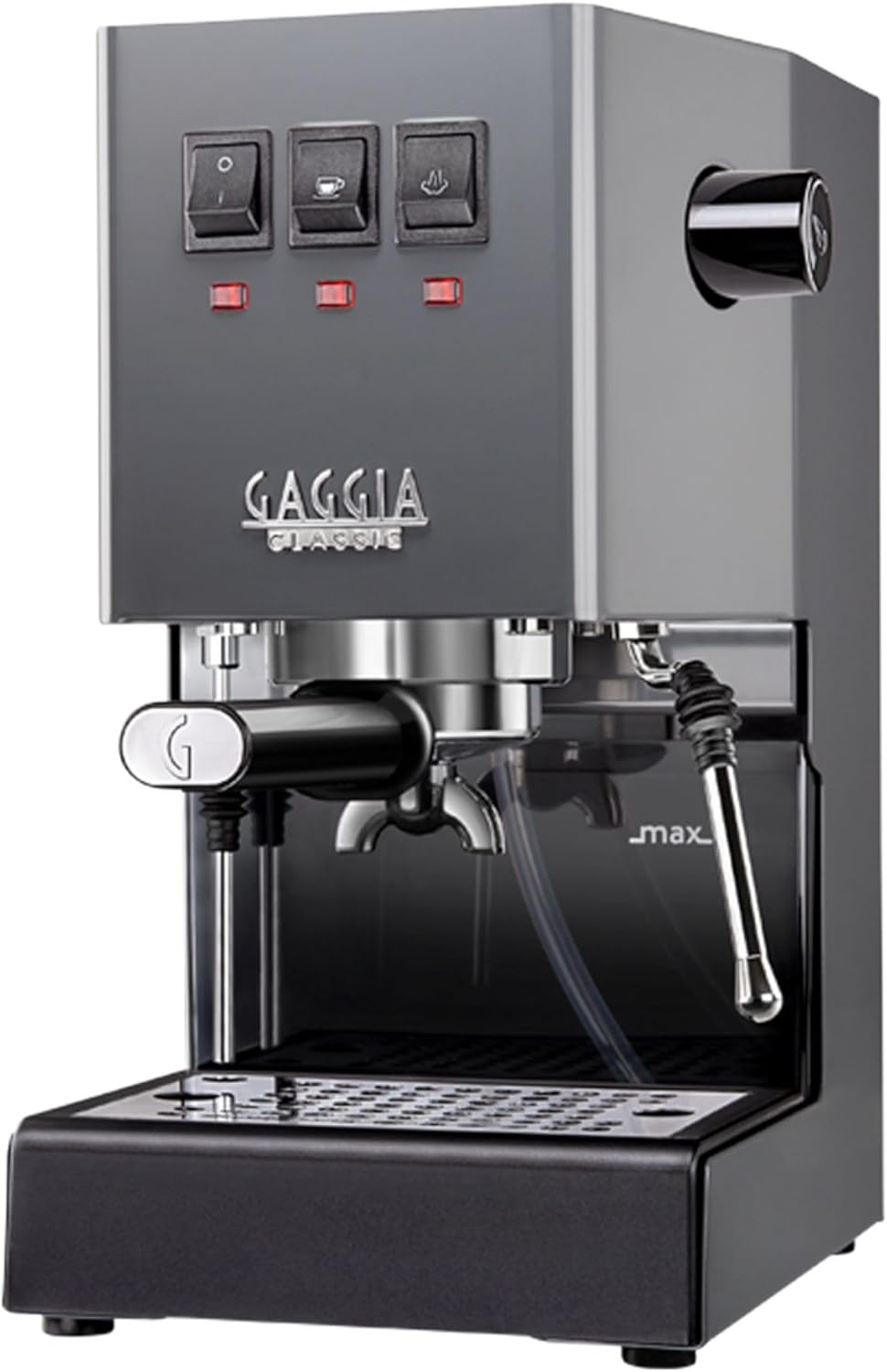
The Gaggia Classic Evo Pro is the pick for the beginner who suspects they are about to fall deep down the espresso rabbit hole. It is a made-in-Italy single-boiler machine built around a commercial 58mm portafilter — the same size used in cafés — which means the accessories and habits you build on it transfer directly to serious gear later.
Crucially, the Evo Pro ships with an OPV set to extract at 9 bars, the pressure the Specialty Coffee Association recommends. Where the Breville hides its workings behind a friendly interface, the Gaggia is honest, mechanical, and endlessly tinkerable. Three rocker switches control power, brew, and steam. That is the whole interface, and enthusiasts love it precisely because there is so little between you and the coffee.
The learning curve is a touch steeper than the Breville's, and like the Stilosa it has no grinder, so budget for one separately. But few machines reward practice like this one. It has a decades-long modding community, holds its value, and can grow with you for years rather than being outgrown in one. For a beginner who wants their first machine to also be their long-term machine, it is the smart bet.
Key Specs#
Type : Semi-automatic single-boiler, no built-in grinder
Pump Pressure : 15-bar pump with OPV tuned to 9-bar extraction (SCA standard)
Portafilter : Commercial 58mm — café-compatible for future upgrades
Controls : Three rocker switches (power, brew, steam) with indicator lights
Steam Wand : Commercial-style wand for latte-art-capable microfoam
Water Tank : Roughly 2.1L removable reservoir
Build : Made in Italy, upgrade-friendly with a large modding community
Bottom line#
The one machine here you are unlikely to outgrow: café-standard fittings and a tinker-friendly design make it the best long-term investment for a committed beginner.
Which one should you buy?#
If you want the shortest path to good espresso, buy the Breville Barista Express. It is the only pick with a built-in grinder, so you are pulling fresh shots the day it arrives without assembling a whole coffee kit. It costs the most, but it replaces two purchases and removes the biggest beginner pitfall.
If you are testing whether espresso is even your thing, buy the De'Longhi Stilosa. It is a genuine pump machine at a price that stings very little if the hobby does not stick. Add a modest grinder and you have a complete, compact setup for less than the Breville alone.
If you already suspect you will get serious, buy the Gaggia Classic Evo Pro. Its commercial 58mm portafilter and 9-bar extraction mean your skills and accessories carry forward, and its modding community will keep it relevant for years. Pair it with a quality grinder and it becomes a machine you grow into, not out of.
For most first-time buyers who want minimal fuss, the Breville is the safe, satisfying default. Choose the Stilosa to save money, or the Gaggia to future-proof.
FAQ#
Which espresso machine is best for a complete beginner?#
The Breville Barista Express is the most beginner-friendly because it grinds beans, controls temperature, and pulls shots all in one machine. That eliminates the two most common early mistakes — stale grounds and unstable temperature — and gets you drinkable espresso faster than a separate grinder-plus-machine setup.
Do I need a separate grinder for these espresso machines?#
Only for the De'Longhi Stilosa and the Gaggia Classic Evo Pro, which do not include grinders. The Breville Barista Express has one built in. If you buy either grinder-free machine, budget for a burr grinder — freshly ground coffee affects shot quality more than the machine itself.
Is the Gaggia Classic Evo Pro too advanced for a first machine?#
No, but it rewards patience. It has a simple three-switch interface and forgiving mechanics, yet its café-standard 58mm portafilter and 9-bar extraction let you keep improving for years. It is the best choice if you expect espresso to become a serious hobby rather than an occasional treat.
Can these machines make lattes and cappuccinos?#
Yes. All three include a manual steam wand to froth and steam milk for lattes, cappuccinos, and flat whites. Steaming milk is a skill you practice, but the Breville and Gaggia wands in particular can produce the microfoam needed for latte art once you get the hang of it.
Why not just buy a pod or capsule machine?#
Pod machines are convenient but lock you into pricey capsules and give you no control over grind, dose, or extraction. Every machine here uses a real portafilter and fresh coffee, which produces better espresso and far lower cost per cup — the trade is a modest learning curve.
Are cheap espresso machines worth it?#
A budget machine like the De'Longhi Stilosa is worth it as a low-risk entry point. Its pressurized baskets forgive imperfect technique, so you get crema early while you learn. You sacrifice temperature stability and an included grinder, but you spend little to discover whether espresso is a hobby you want to invest in further.