

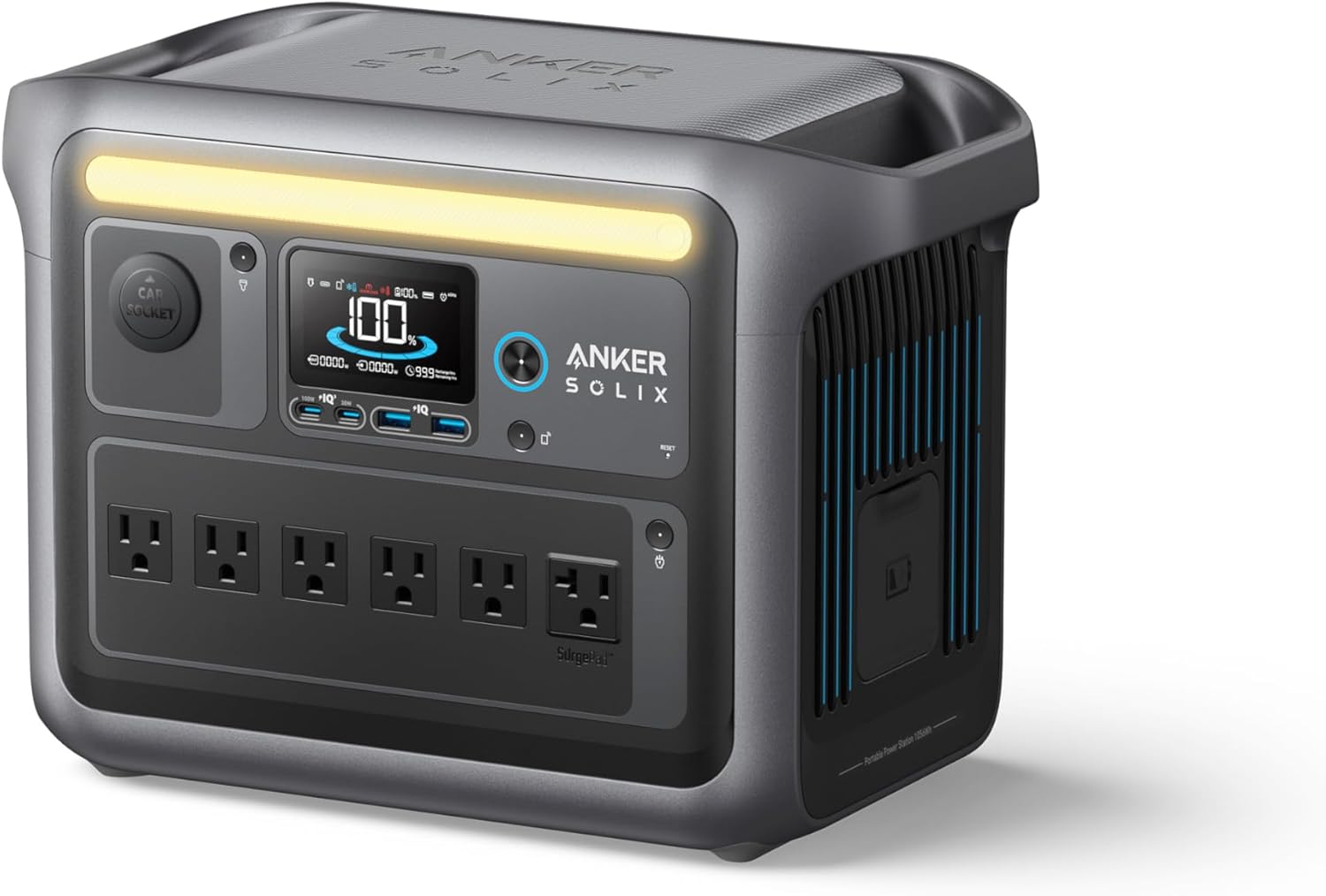
A portable power station is the one piece of gear that covers both a weekend off-grid and the next blackout, and three units stand out in 2026. The Anker SOLIX C1000 is the best overall — a compact 1056Wh unit that recharges in under an hour with its app-enabled UltraFast mode. The EcoFlow River 3 is the best budget and lightest pick at 7.8 pounds. The Jackery Explorer 2000 v2 is the best for extended off-grid, with 2042Wh to run a campsite or fridge for days.
All three use LiFePO4 (lithium iron phosphate) batteries, the chemistry that now defines a good power station: it runs thousands of charge cycles, tolerates heat far better than older lithium packs, and holds up for roughly a decade of regular use. The difference between them is not quality — it's size, weight, and how much of your life you want to keep running when the wall outlet goes away.
The trap most buyers fall into is chasing the biggest number. A 2000Wh station is wasted weight if you only ever charge phones, a laptop, and a camp light — and a 245Wh unit will leave you dark if you expected to run a full-size fridge overnight. Match the capacity to the job and every one of these is an easy recommendation. If your only real need is topping up phones and laptops, a high-capacity power bank is lighter and cheaper than any of these — a power station earns its size once you need to run AC appliances.
Who this comparison is for#
- Campers, van-lifers, and tailgaters who need to run lights, a cooler, phones, and a laptop away from any outlet.
- Homeowners in storm or wildfire-prone areas who want a silent, fume-free backup to keep a fridge, router, and a few devices alive through an outage.
- Anyone who wants one flexible battery for both jobs, and would rather buy the right size once than guess.
How we picked#
- LiFePO4 only. Every pick uses a lithium iron phosphate battery — thousands of cycles, better heat tolerance, and a lifespan measured in years rather than months. We skipped older-chemistry units entirely.
- Real recharge speed. A power station you can top up in an hour is far more useful than one that needs a full day. We weighted fast AC recharge and solar input heavily.
- Fume-free and indoor-safe. Unlike a gas generator, none of these burns anything, so all three are safe to use inside a tent, RV, or house. On noise, EcoFlow rates the River 3 at under 30 dB at 1.5 ft; Jackery rates the Explorer 2000 v2 at 30 dB in Quiet Mode and 45 dB at full load; Anker publishes no noise figure for the C1000.
- Matched to a clear job. We deliberately chose three different sizes — a do-everything mid-size, a featherweight budget unit, and a multi-day powerhouse — so the roundup covers real use cases instead of three near-identical boxes.
- Proven brands, current models. Anker, EcoFlow, and Jackery are the three most-reviewed names in the category, and every pick is still listed on its maker's own store rather than being a clearance-bin leftover.
Capacity vs output: the two numbers that matter#
Two specs decide whether a power station fits your life, and they answer different questions. Capacity (watt-hours, Wh) is how much energy the battery holds — it sets how long it runs your gear. Continuous output (watts, W) is how much it can push at once — it sets what you can plug in. A big battery with weak output can run a phone for days but can't start a microwave; a strong output with a small battery can run the microwave, but only briefly.
Watt-hours translate roughly into runtime: divide the capacity by an appliance's draw. A 60W mini-fridge pulls about 60Wh an hour, so the Anker's 1056Wh keeps it cold for the better part of a day, while the Jackery's 2042Wh takes that past a day and a half. A laptop sips 30–60W; a phone barely 10W. (Jackery's own runtime calculator applies an 82% efficiency factor, so treat these divisions as ceilings rather than promises.) That's why the 245Wh EcoFlow is plenty for devices but not for a fridge, and why chasing the biggest battery only makes sense once your loads are genuinely large.
Then watch the surge figure. Motors and compressors — fridges, pumps, some power tools — briefly draw two to three times their running wattage at startup. A unit rated 300W continuous can stall on a device the label says it should handle, which is exactly what surge headroom exists to cover — the River 3's 600W surge and the Anker's 2400W SurgePad. If you plan to run anything with a motor, size up on output, not just capacity.
Anker SOLIX C1000 — Best Overall#
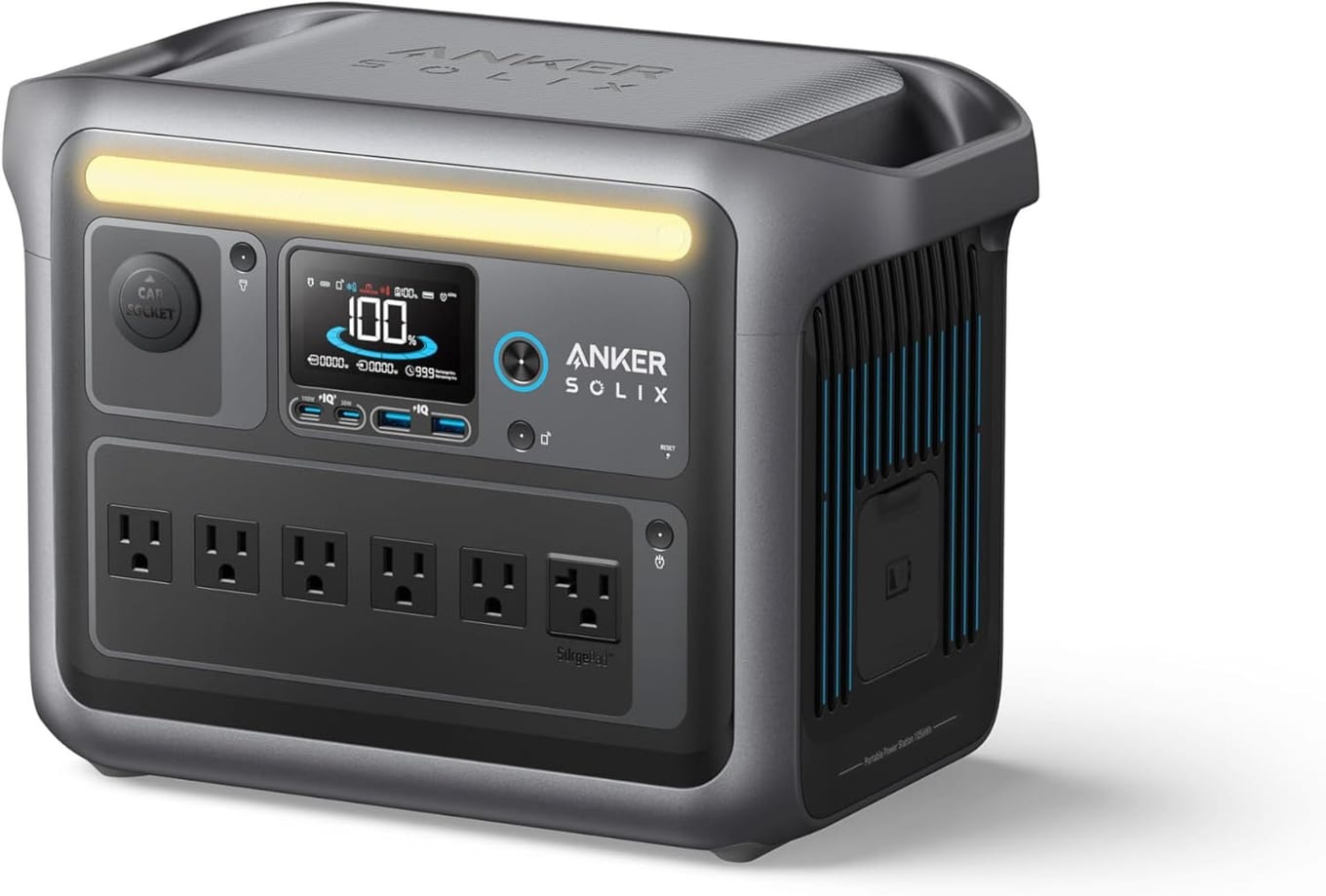
The Anker SOLIX C1000 is the power station most people should buy because it sits exactly where the value is: enough capacity to matter, small enough to carry, and fast enough to refill that you never wait on it. Its 1056Wh LiFePO4 battery is the sweet spot for a long weekend of camping or a full blackout — it will keep a fridge, phones, a laptop, lights, and a router going far longer than a compact unit, without the dead weight of a 2000Wh box you rarely fill.
Where the C1000 pulls ahead is charging. It refills to 80% in about 43 minutes and to a full charge in roughly 58 minutes from a wall outlet — the fastest of this trio by a wide margin. Two conditions come with that number, and Anker states both on the listing: UltraFast recharging has to be switched on in the Anker app, which means you need a smartphone paired to the unit, and Anker gives UltraFast an operating temperature range of 68–122°F (20–50°C), so a cold — or a very hot — unit charges considerably more slowly. It also accepts up to 600W of solar, and Anker rates a full solar refill at 1.8 hours.
The output is where it earns "best overall." Continuous 1800W of pure sine wave with a 2400W SurgePad peak means it runs high-startup appliances that trip lesser units — a microwave, a coffee maker, a full-size fridge, even many power tools. Eleven ports — six AC outlets, a 100W and a 30W USB-C, two 12W USB-A, and a 12V/10A car socket — mean you rarely need an adapter. At 28.44 lb (12.9 kg) it's genuinely one-hand portable, and the LiFePO4 cells are rated for 3,000 cycles to 80% capacity, which Anker frames as roughly a decade of regular use.
One thing to know before you buy: Anker now also sells a C1000 Gen 2, and it is not a straight upgrade. The Gen 2 is smaller and lighter with more output (2,000W continuous, 3,000W peak) but slightly less battery at 1,024Wh, and Anker's own FAQ says it drops the expansion feature — "For users who need expandable capacity, C1000 is recommended." The original, the model reviewed here, is the one that takes the BP1000 expansion battery for a second 1,056Wh.
Key specs#
Battery capacity : 1056Wh, LiFePO4 (lithium iron phosphate)
Continuous output : 1800W pure sine wave (2400W SurgePad peak)
Ports : 11 total — 6 AC outlets, USB-C 100W, USB-C 30W, 2 × USB-A 12W, and a 12V/10A car socket
AC recharge : ~58 minutes to full, 80% in ~43 minutes — requires UltraFast enabled in the Anker app and cells above 20°C (68°F)
Solar input : Up to 600W (full refill in 1.8 hours, per Anker)
Battery life : 3,000 cycles to 80% capacity (about 10 years); 5-year warranty
Weight : 28.44 lb (12.9 kg)
Dimensions : 14.8 × 8.07 × 10.5 in (37.6 × 20.5 × 26.7 cm)
Best for : The buyer who wants one do-everything unit for both camping and home backup
Bottom line. The C1000 refills faster than anything else here and runs almost any appliance you'll plug into it, all in a size you can carry one-handed. It's the default pick for a reason.
EcoFlow River 3 — Best Budget#
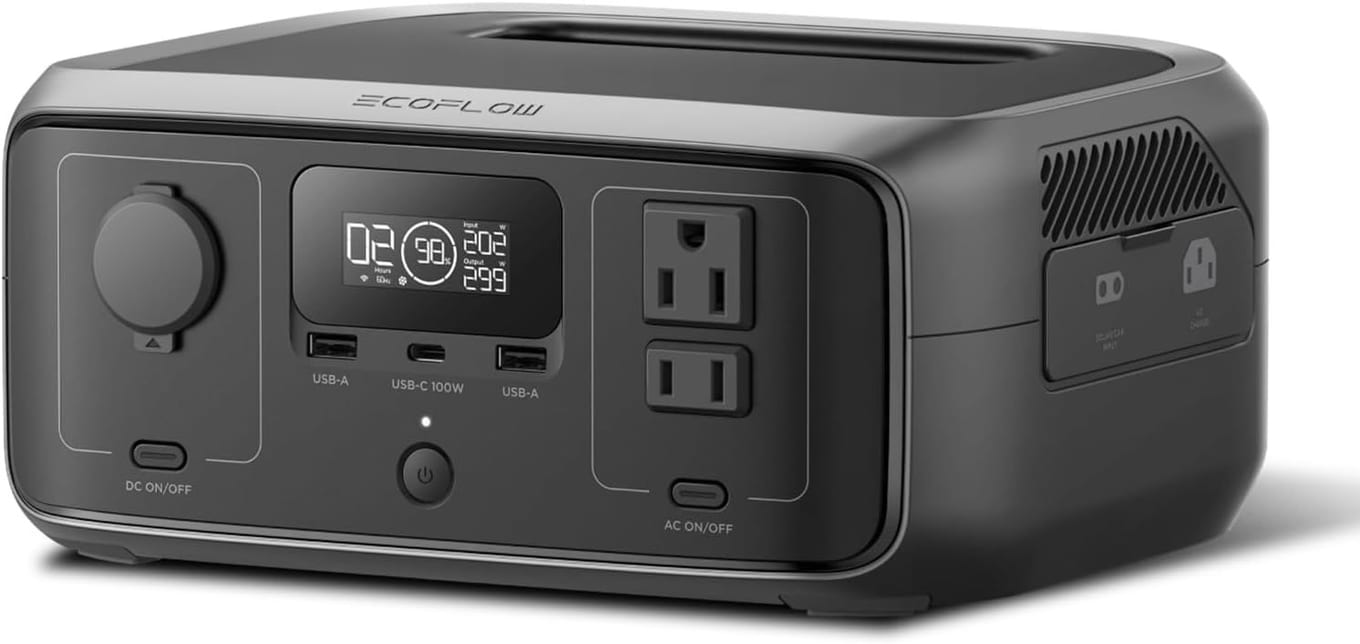
The EcoFlow River 3 is the pick when you want real power-station capability without the size, weight, or spend of a full unit. At 245Wh and just 7.8 pounds, it's the one you actually bring — it slips into a backpack or a car door pocket and disappears until you need it. For keeping phones, a tablet, a drone, a camera, and camp lights topped up over a weekend, it does the job that most people actually have, at a fraction of the cost and weight of the bigger units.
Don't let the small number fool you into thinking it's underpowered for its role. It delivers 300W continuously across its two AC outlets, with a 600W surge, and EcoFlow's X-Boost mode also runs up to 600W of heating-element appliances that a 300W rating says shouldn't fit. It's also one of the fastest-charging units in its class, reaching a full charge in an hour from a wall outlet on 320W of AC input, so a quick top-up before you leave the house is all it takes. Solar input is capped at 110W, which EcoFlow rates at 2.6 hours to full — enough to keep it topped up at a campsite, not enough to make it a solar workhorse like the other two.
Three details make it a great travel companion. It runs at under 30 dB measured at 1.5 ft, quiet enough to sit beside you in a tent; its battery carries IP54 protection, so a little dust or a light splash on a campsite won't kill it; and it carries the same sub-20 ms UPS switchover as the big Jackery, so it can sit between the wall and a router. Its six output ports are two AC outlets, a 100W USB-C, two 12W USB-A and a car socket. This is the best budget pick precisely because it's honest about its job — it's a featherweight everyday-and-weekend battery, not a house backup.
Key specs#
Battery capacity : 245Wh, LiFePO4 (lithium iron phosphate)
Continuous output : 300W across 2 AC outlets (600W surge; X-Boost 600W)
Ports : 6 output ports — 2 AC outlets, USB-C 100W, 2 × USB-A 12W, and a 12.6V/10A car socket
AC recharge : 0–100% in 60 minutes on 320W AC input
Solar input : 110W (0–100% in as fast as 2.6 hours)
Battery life : 3,000 cycles to 80% capacity
Durability : IP54 applies to the battery pack only, not the whole unit; under 30 dB at 1.5 ft; UPS switchover under 20 ms
Weight : 7.8 lb
Dimensions : 10 × 8.3 × 4.4 in
Best for : Budget buyers and minimalist campers who mainly charge phones, laptops, and small gear
Bottom line. The lightest and most affordable pick here, and quiet enough to sit in your tent. If you don't need to run big appliances, this is all the power station most people ever use.
Jackery Explorer 2000 v2 — Best for Extended Off-Grid#
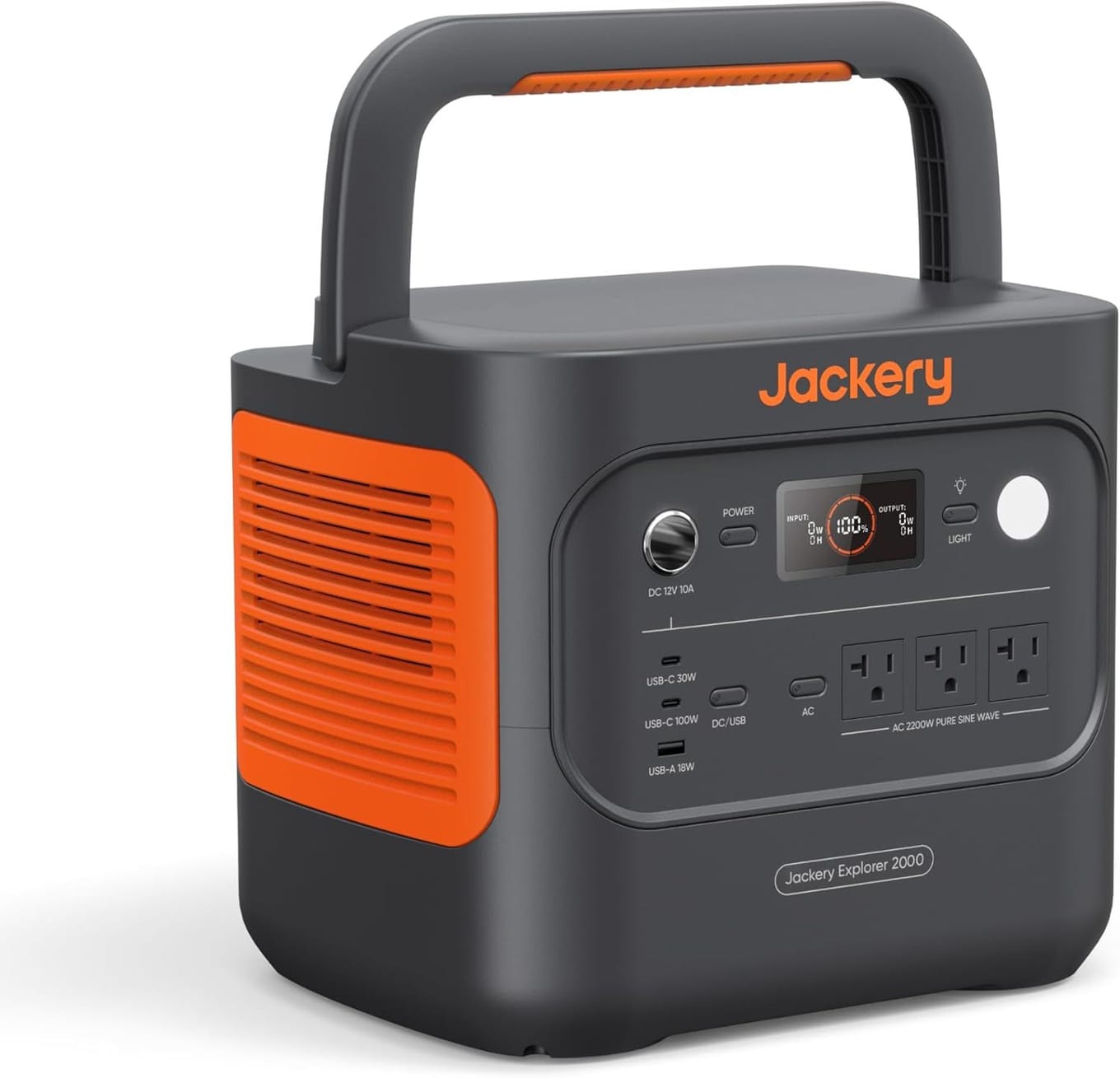
The Jackery Explorer 2000 v2 is the one you buy when you need to run real life off-grid for days, not hours. Its 2042Wh LiFePO4 battery is nearly double the Anker's and roughly eight times the EcoFlow's, which is the difference between topping up devices and actually living off the battery — running a full-size fridge, a CPAP every night, power tools on a remote job site, or the essentials of a house through a multi-day outage. If your plans involve a base camp, an RV, or serious storm prep, this is the tier you want.
The output backs up the big battery. Its three AC outlets deliver 2200W continuously with a 4400W surge, enough headroom to start and run demanding appliances that smaller stations refuse — a full-size refrigerator, a coffee maker, a circular saw. Of its two USB-C ports the larger pushes 100W, so it fast-charges a laptop directly, and a sub-20 ms UPS switchover — UL1778 test certified — means it can sit between the wall and your fridge or desktop and take over instantly when the grid drops, with no reboot.
Jackery kept it surprisingly livable for its capacity. It weighs 39.5 lb (17.9 kg) at 13.2 × 10.4 × 11.5 in, gets from 0 to 80% in about 66 minutes and to full in 1.75 hours on Jackery's spec sheet, with its app-enabled Emergency Super Charge mode rated separately at 102 minutes, and it runs at 30 dB in its Quiet Mode, rising to 45 dB at full load — Jackery measures both at one metre. Like the other two it burns nothing, which is the actual reason it is indoor-safe. The LiFePO4 pack is rated for 4,000 cycles to 70% or better, the longest-lived of the three. It's the heaviest and largest pick here by design — that's the price of multi-day autonomy — but nothing else in this roundup keeps a household running the way it does.
Key specs#
Battery capacity : 2042Wh, LiFePO4 (lithium iron phosphate)
Continuous output : 2200W (4400W surge)
Ports : 3 AC outlets, USB-C 100W, USB-C 30W, USB-A 18W, and a 12V/10A car socket
AC recharge : 1.75 hours to full on Jackery's spec sheet; 0–80% in ~66 minutes; app-enabled Emergency Super Charge rated at 102 minutes
UPS switchover : Under 20 ms, UL1778 test certified
Battery life : 4,000 cycles to 70%+ capacity (about 10 years); 3-year warranty, with Jackery's extra 2 free years applying only to purchases made at jackery.com
Weight : 39.5 lb (17.9 kg)
Dimensions : 13.2 × 10.4 × 11.5 in (33.5 × 26.4 × 29.2 cm)
Best for : Multi-day off-grid trips, RV power, and whole-essentials home backup
Bottom line. The powerhouse of the group. Heavy and large, but it's the only pick here that can keep a fridge and household essentials running for days rather than hours.
Which one should you buy?#
Start with the job, not the spec sheet. If you want one unit that handles both a camping weekend and a blackout without overthinking it, buy the Anker SOLIX C1000. Its 1056Wh capacity runs the appliances that matter, it refills faster than anything else here, and it's light enough to carry with one hand. For most people, this is the right answer.
If you're on a budget, or you simply want the lightest thing that still counts as a power station, buy the EcoFlow River 3. It's the one you'll actually pack, it charges phones, laptops, and small gear all weekend, and X-Boost lets it punch above its size for up to 600W of heating-element loads. Just be honest with yourself: it is not a house backup.
If you need to live off the battery — multi-day camping, an RV, a job site, or keeping a fridge and essentials alive through a long outage — buy the Jackery Explorer 2000 v2. It's the heaviest and largest pick, but that weight buys you days of autonomy and the headroom to run big appliances nothing else here can start.
A simple way to decide: if you're charging devices, go small (EcoFlow). If you're running appliances for a weekend, go mid-size (Anker). If you're powering essentials for days, go big (Jackery).
FAQ#
What can each of these power stations actually run?#
The EcoFlow River 3 (245Wh) is built for devices — phones, laptops, cameras, camp lights — with X-Boost adding up to 600W of heating-element loads. The Anker C1000 (1056Wh, 1800W) runs full-size appliances like a fridge, microwave, or coffee maker for hours. The Jackery 2000 v2 (2042Wh, 2200W) does the same but for days, and starts higher-draw gear like power tools thanks to its 4400W surge.
Are these safe to use indoors or in a tent?#
Yes. Unlike gas generators, all three are battery power stations that burn nothing and produce no exhaust fumes, which is what makes them safe inside a tent, RV, or home during an outage — a fuel-burning generator never is. On noise, EcoFlow rates the River 3 at under 30 dB at 1.5 ft; Jackery rates the Explorer 2000 v2 at 30 dB in Quiet Mode and 45 dB at full load, both measured at one metre; and Anker publishes no noise figure for the C1000, so we won't put one in its mouth.
How long do LiFePO4 power stations last?#
All three use LiFePO4 (lithium iron phosphate) batteries, and all three publish a cycle rating: 3,000 cycles to 80% capacity for both the Anker C1000 and the EcoFlow River 3, and 4,000 cycles to 70% or better for the Jackery Explorer 2000 v2. In practical terms each maker frames that as roughly a decade of regular use before the battery drops to a noticeably reduced capacity, far longer than the older lithium chemistries these replaced.
Can I recharge them with solar panels?#
Yes, all three accept solar input (panels sold separately), but the ceilings differ sharply: 600W on the Anker C1000, which Anker rates at a 1.8-hour full refill; 400W on the Jackery; and just 110W on the EcoFlow River 3, rated at 2.6 hours to full. That is why the Anker and the Jackery are the two that stay viable off-grid for days.
Do I need the biggest one?#
No — and buying too big is the most common mistake. A 2000Wh unit is dead weight if you only charge phones and a laptop, and a 245Wh unit won't cover a fridge overnight. Match the capacity to your real load: small for devices, mid-size for a weekend of appliances, large for multi-day or whole-home essentials.
Which is best for a first-time buyer?#
For most first-time buyers, the Anker SOLIX C1000 is the safest choice. It's big enough to be genuinely useful for both camping and home backup, small and light enough not to intimidate, and its fast recharge means you're never stuck waiting. Step down to the EcoFlow River 3 if budget or portability is the priority, or up to the Jackery 2000 v2 if you already know you need days of runtime.