

For home DIY, the DeWalt DCD771C2 is the best overall pick — a two-speed 20V drill with the muscle for wood, metal, and light masonry. The BLACK+DECKER LDX120C is the best budget option for hanging shelves and flat-pack furniture, and the Bosch PS31-2A is the best for tight spaces thanks to its featherweight 12V body.
Who this comparison is for#
This roundup is for the home DIYer, not the working tradesperson. You want one dependable drill that handles the jobs that actually come up around a house or apartment.
- Homeowners tackling shelves, curtain rods, deck repairs, and the occasional wall anchor into masonry.
- Renters and apartment dwellers who need a compact, light drill for furniture assembly and picture hanging without a workshop.
- First-time tool buyers who want a trustworthy brand and a battery platform they can grow into, without overpaying for pro-grade features they will never use.
How we picked#
We focused on drills that a non-professional will actually reach for, judged against the criteria that matter for household work rather than job-site abuse.
- Right power band: enough torque for driving long screws and boring into studs and light masonry, without the bulk of a hammer drill you do not need.
- Battery included: every pick ships with at least one battery and a charger, so you can work out of the box with no hidden add-on cost.
- Weight and balance: a drill you can hold overhead for a ceiling fixture matters more at home than raw specs on a box.
- Proven reliability: every pick comes from a brand with a real service network.
- Value at every tier: one all-rounder, one genuine budget choice, and one specialist for cramped cabinets and closets.
DeWalt DCD771C2 (Best Overall)#
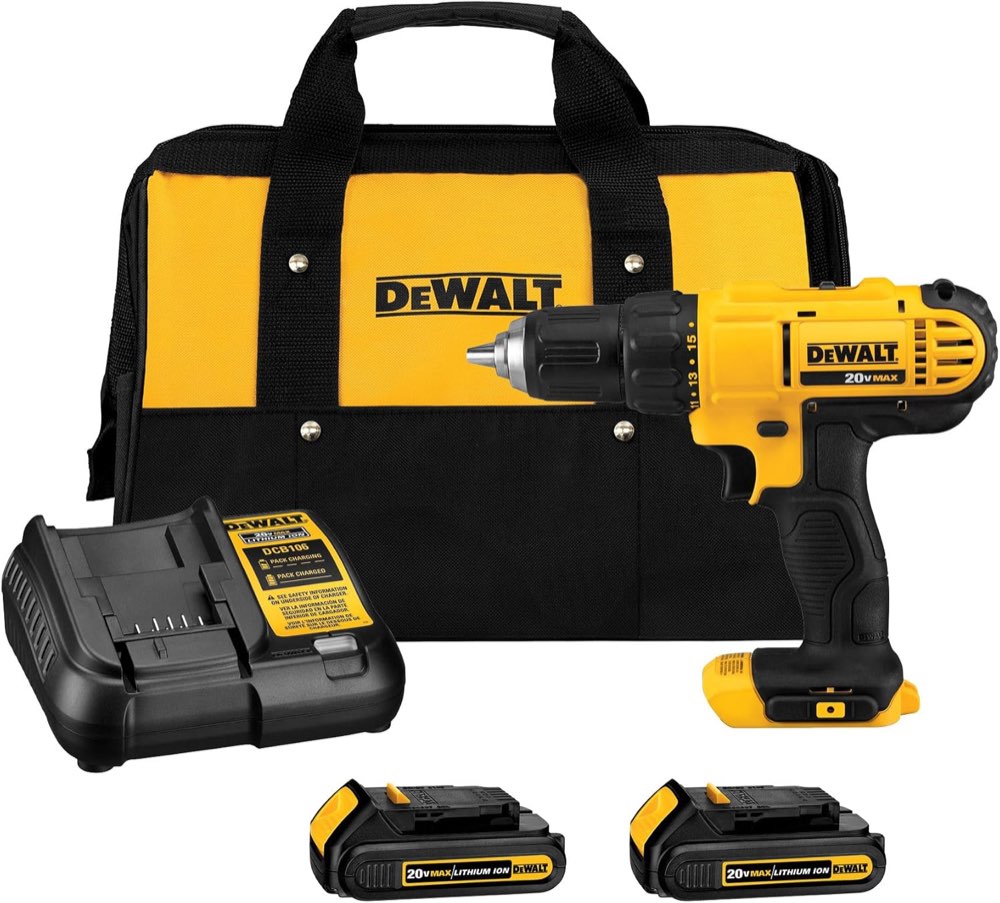
The DeWalt DCD771C2 is the drill we would hand almost any homeowner first. It is a 20V MAX two-speed drill/driver that sits in the sweet spot between the throwaway budget tools and the heavy brushless kits built for daily contractor use. For the price of a nice dinner out, you get real drilling capability and a battery platform DeWalt supports across hundreds of tools.
What makes it the overall pick is versatility. The high-performance motor delivers up to 300 unit watts out (UWO) of power, and the two-speed transmission lets you drop into low gear for high-torque driving of long deck screws, then shift to high speed (up to 1,500 RPM) for fast, clean drilling through wood and metal. A 1/2-inch keyless chuck accepts larger bits and spade bits that budget 3/8-inch drills simply cannot hold. The kit includes two batteries, so one is always charging while you work.
At just over 3.6 pounds with a compact 8.5-inch front-to-back length, it is light enough for overhead work yet substantial enough that it never feels like a toy. If you buy into the DeWalt 20V MAX system now, the same batteries later power impact drivers, saws, and yard tools.
Key Specs#
Voltage : 20V MAX (18V nominal) lithium-ion
Chuck : 1/2-inch (13mm) keyless, single sleeve
Speed : Two-speed, 0–450 / 0–1,500 RPM
Max Torque : 300 unit watts out (UWO)
Weight : 3.64 lbs (with battery)
In the Box : Drill, two 1.3Ah batteries, charger, contractor bag
Bottom line#
The best balance of power, weight, and long-term value for the widest range of household jobs.
BLACK+DECKER LDX120C (Best Budget)#
The BLACK+DECKER LDX120C is the drill to buy when you want a real cordless tool without spending real money. It costs roughly half of the DeWalt and still covers the jobs most people actually do: assembling furniture, hanging shelves and mirrors, mounting curtain rods, and driving small anchors into drywall.
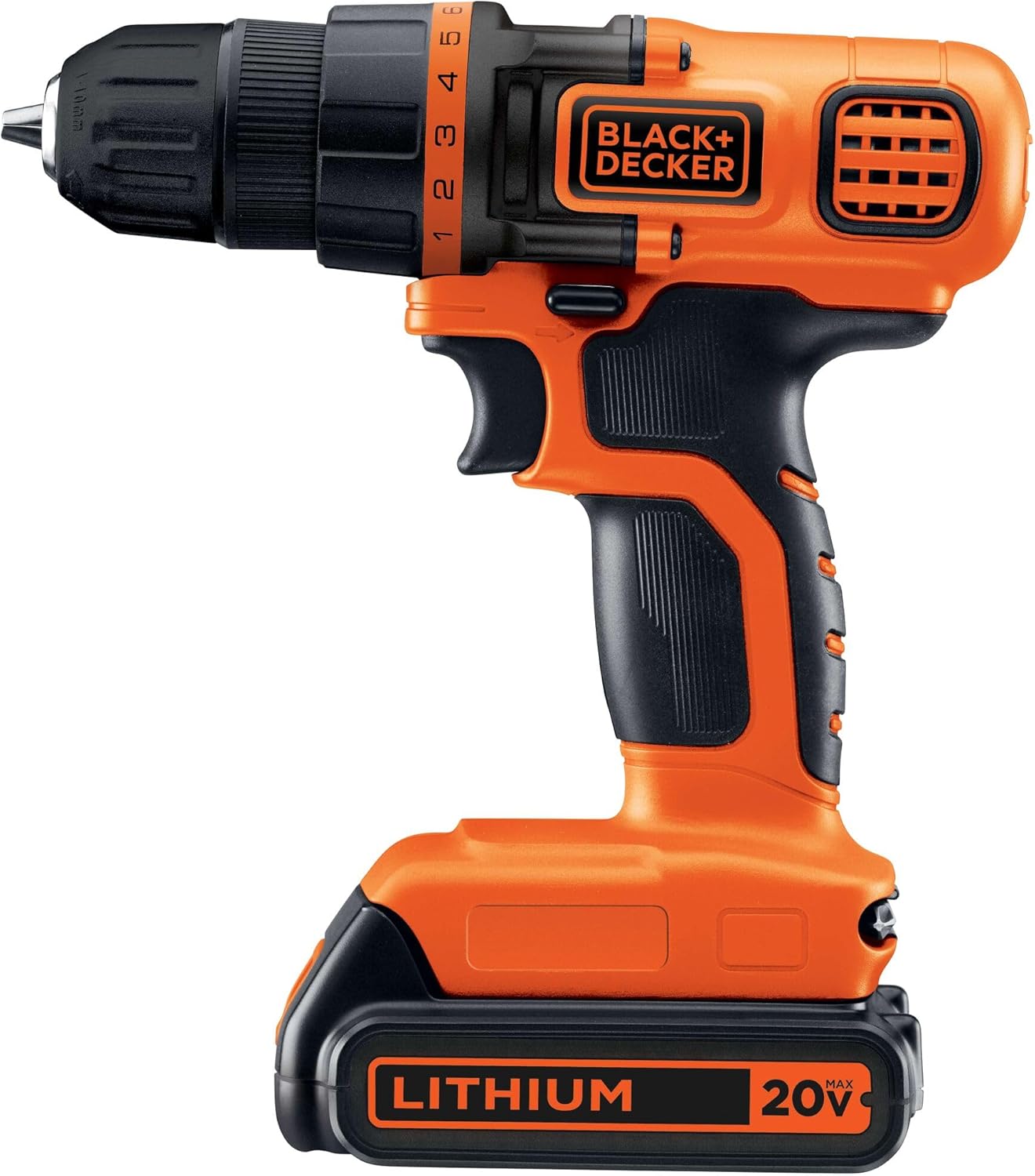
This is a 20V MAX drill built around simplicity. It runs a single-speed transmission with a variable-speed trigger topping out at 650 RPM and an 11-position clutch that helps you set fasteners without stripping screw heads or sinking them too deep into soft pine. An LED work light sits above the trigger, which is genuinely useful inside a dark cabinet or behind a headboard. At 3.4 pounds it is easy to control one-handed for long stretches of flat-pack assembly.
The trade-offs are honest ones. The 3/8-inch chuck limits you to smaller bits, the single speed range means slower going in dense hardwood, and the brushed motor is less efficient than premium brushless designs. None of that matters much for light, occasional home use. For a renter or a first apartment, it is the most sensible money you can spend on a drill.
Key Specs#
Voltage : 20V MAX (18V nominal) lithium-ion
Chuck : 3/8-inch (10mm) keyless
Speed : Single-speed, 0–650 RPM
Clutch : 11 positions plus drill mode
Weight : 3.4 lbs (with battery)
In the Box : Drill, 1.5Ah battery, charger
Bottom line#
The cheapest drill we trust for real household jobs — ideal for renters and first-time buyers.
Bosch PS31-2A (Best for Tight Spaces)#
The Bosch PS31-2A is the drill you want when the job is in a corner, a cabinet, or over your head. It runs on Bosch's 12V Max platform, which trades the raw grunt of an 18V/20V tool for a dramatically smaller, lighter body — and for interior home work, that trade is often the right one.
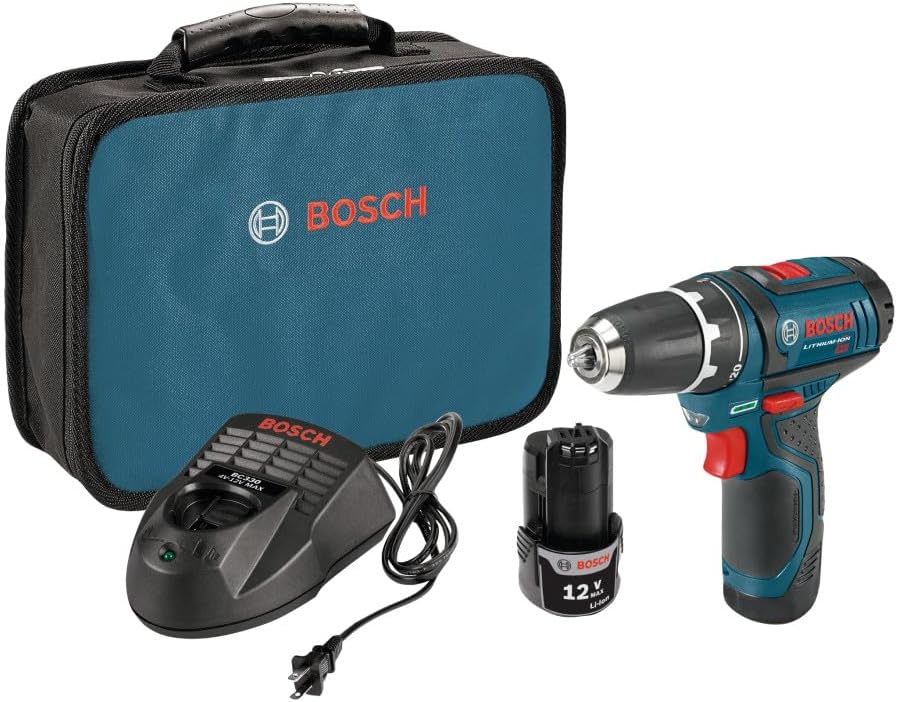
The standout number is the head length: at roughly 7 inches nose to back, it fits between wall studs and inside kitchen cabinets where a full-size drill simply will not turn. It weighs about 2 pounds, so you can drive screws into a ceiling bracket without your forearm giving out. Despite the small frame, it is a proper two-speed tool (0–350 and 0–1,300 RPM) with a 20+1 clutch and a genuine 3/8-inch chuck, plus an integrated LED and a battery fuel gauge so you are never surprised by a dead pack. The kit includes two 2.0Ah batteries.
It is not the drill for boring 1-inch holes through joists or drilling masonry all day — the 12V platform runs out of torque before an 18V tool would. But for assembly, cabinetry, electronics, and precision work in confined spaces, its size-to-capability ratio is hard to beat.
Key Specs#
Voltage : 12V Max (10.8V nominal) lithium-ion
Chuck : 3/8-inch (10mm) keyless
Speed : Two-speed, 0–350 / 0–1,300 RPM
Head Length : ~7 inches (compact)
Weight : ~2.0 lbs (with battery)
In the Box : Drill, two 2.0Ah batteries, charger, bits, bag
Bottom line#
The most maneuverable pick here — low weight and a short head for cabinet, closet, and overhead work.
Which one should you buy?#
For most people, buy the DeWalt DCD771C2. It has the power range, the 1/2-inch chuck, and the two-battery kit to handle nearly anything a house throws at it, and it plants you on a battery platform you can expand for years. If you only ever own one drill, make it this one.
If money is tight or your needs are genuinely light — furniture, shelves, the odd wall anchor — the BLACK+DECKER LDX120C does that work for roughly half the outlay. It is the smart pick for a first apartment or a rarely-used kitchen-drawer tool.
If your work lives in cramped spaces — inside cabinets, between studs, or overhead where every ounce counts — the Bosch PS31-2A earns its place. Its short head and two-pound weight let you reach spots the bigger drills cannot, and it stays surprisingly capable for its size.
A practical move: if you expect to grow a tool collection, start with the DeWalt for its platform. If you already own 18V/20V tools and just need something nimble, add the Bosch as a dedicated tight-spaces drill.
FAQ#
Is a 12V drill powerful enough for home use?#
For the majority of household jobs — assembling furniture, hanging shelves, driving screws, and drilling into wood and drywall — a 12V drill like the Bosch PS31-2A is plenty. You will feel the limit only on heavy tasks like large-diameter holes in joists or repeated masonry drilling, where an 18V/20V tool like the DeWalt is the better fit.
Do I need a hammer drill or an impact driver instead?#
Not for most home DIY. A standard drill/driver handles wood, metal, drywall, and light masonry anchors. A hammer drill helps only with frequent drilling into brick or concrete, and an impact driver is a specialist for driving long, heavy fasteners fast. Start with a regular drill/driver like these three; add the others later if a project demands it.
What is the difference between a 3/8-inch and a 1/2-inch chuck?#
The chuck is the jaw that grips the bit. A 1/2-inch chuck (like the DeWalt's) accepts larger bits and spade bits for bigger holes, while a 3/8-inch chuck (the BLACK+DECKER and Bosch) is fine for most drilling and driving but caps the bit size. For general home use, 3/8-inch covers most tasks; choose 1/2-inch if you plan to bore larger holes.
Are the batteries included, or do I have to buy them separately?#
All three kits include at least one battery and a charger, so you can work right out of the box. The DeWalt and Bosch kits each include two batteries, letting you swap while one charges. The BLACK+DECKER ships with a single battery, which is fine for shorter, occasional jobs.
Can I use these drills to mix paint or drive lag bolts?#
Light mixing of paint or thin-set is possible with the DeWalt in low gear, but sustained heavy mixing is hard on any compact drill and better suited to a dedicated mixer. For occasional lag bolts, the DeWalt's low-speed torque is the strongest of the three; the budget BLACK+DECKER will struggle with large lags.
How long do the batteries last per charge?#
Runtime depends on the task, but for typical light home use — driving a few dozen screws or drilling a handful of holes — any of these will run for a good stretch of a project before needing a top-up. The two-battery DeWalt and Bosch kits effectively double your working time since you always have a charged spare on hand.