

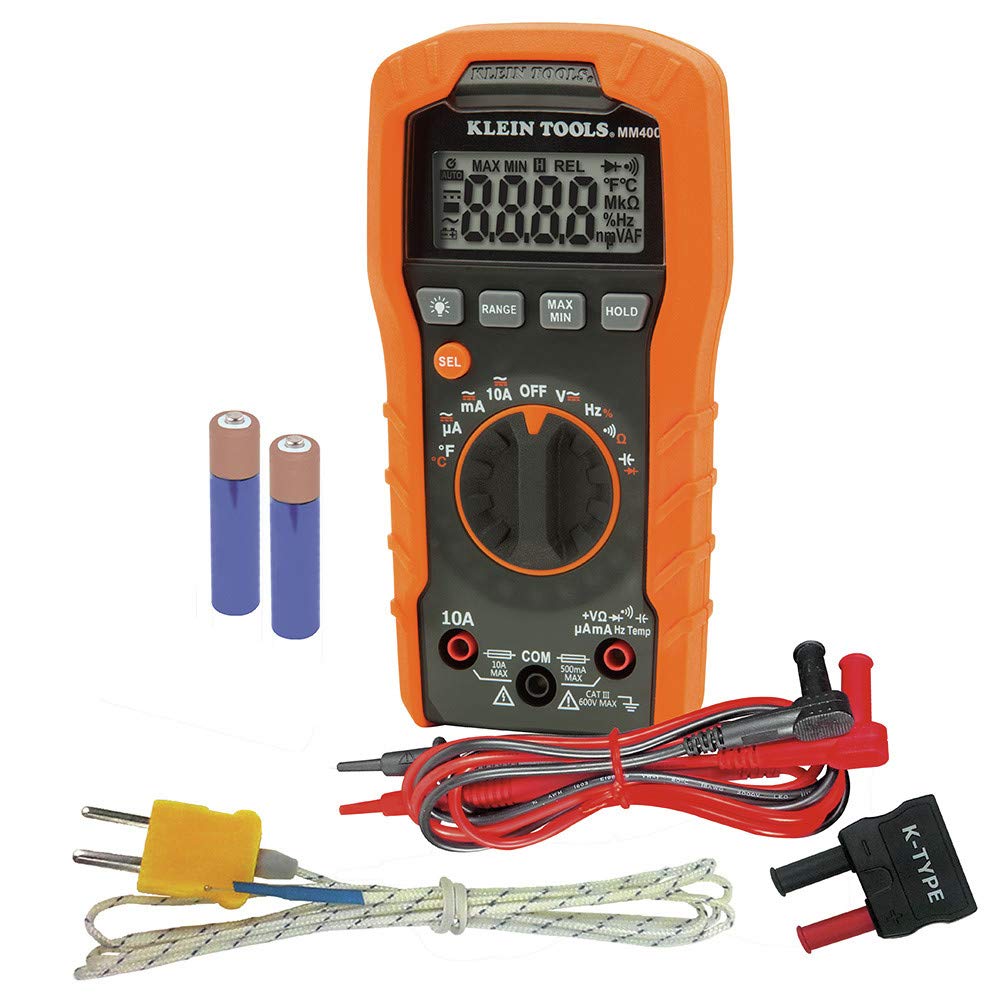
Best 3 digital multimeters for home electrical work: the Klein Tools MM420 is the best overall for auto-ranging true-RMS simplicity, the AstroAI DM6000AR is the best budget pick, and the Fluke 117 is the best for live panel work thanks to built-in non-contact voltage detection.
Who this comparison is for#
- Homeowners who do their own electrical work — replacing outlets, swapping light switches, tracing a dead circuit, or checking whether a breaker actually killed the wire you are about to touch.
- Appliance and HVAC DIYers who need to test capacitors, thermostat wiring, and heating elements before ordering a replacement part.
- Anyone upgrading from a non-contact voltage pen who has hit the limits of "it beeps or it doesn't" and needs real numbers.
If you build circuit boards or debug microcontrollers, this is the wrong list — you want a bench meter with better low-current resolution. Everything here is aimed at 120V and 240V household wiring.
How we picked#
- CAT III 600V minimum. Household branch circuits and breaker panels demand a CAT III rating. A meter rated CAT II only is legal to sell and dangerous to use at a panel, where an arc fault has the whole service transformer behind it.
- True RMS across the board. Modern homes are full of LED drivers, variable-speed motors, and switching supplies that produce non-sinusoidal waveforms. Averaging meters misread these; all three picks here are true-RMS.
- Fused current inputs. A meter without properly fused amp jacks turns a misplaced probe into an explosion. The Klein and the AstroAI fuse both of their current jacks; the Fluke has only one current jack and fuses it.
- Usable in one hand, on a ladder, in a dark crawlspace. Backlit display, an audible continuity buzzer you can hear over an HVAC blower, and a case that survives a drop from chest height.
Klein Tools MM420 — Best Overall#
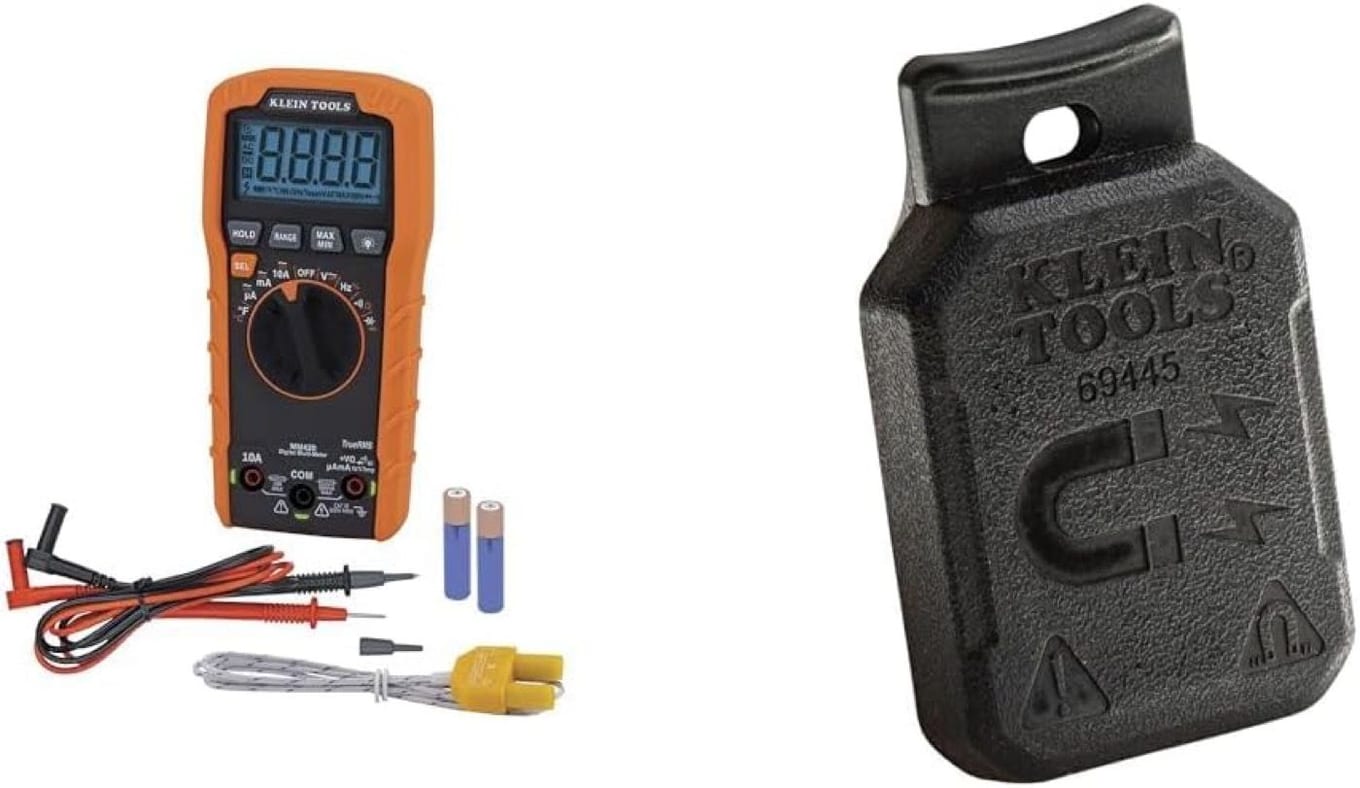
The Klein MM420 is the meter most electricians hand to an apprentice, and that is exactly why it works so well for homeowners. It is auto-ranging, so you turn the dial to "V" and it figures out whether you handed it 3 volts or 240. There is no range-guessing step, which is the single most common place a beginner reads a meaningless number and concludes the circuit is dead. When you do want control, the RANGE button steps through ranges manually and a one-second hold gives auto-ranging back.
It is also a true-RMS meter, which is what moves it above the MM400 it replaced. Klein describes it as "an auto-ranging, true root mean square (TRMS) multimeter", and TrueRMS is printed on the meter's face. That matters the moment you measure anything downstream of a dimmer, an LED driver or a variable-speed motor — the exact circuits a modern house is full of.
Its measurement set covers everything a house throws at you: AC and DC voltage to 600V, AC and DC current to 10A, 50 MΩ resistance, continuity, capacitance to 400 µF, frequency from 1 Hz to 50 kHz, duty cycle, diode test, and temperature from -40°F all the way to 1832°F. Read that last one carefully, though: the meter reaches 1832°F but Klein's manual says the bundled probe "is suitable for temperatures below 356°F / 180°C only", and anything hotter needs a higher-range K-type thermocouple. The capacitance range is the quiet hero — it is what lets you test the run capacitor on an air-conditioner condenser instead of guessing and buying a new one.
The MM420 also adds a small safety feature the MM400 did not have: Lead Alert LEDs beside the jacks light up when you turn the dial to a measurement setting, confirming the leads are in the right holes before you touch anything. They switch themselves off after two minutes. The supplied leads come with CAT III/CAT IV safety caps, and continuity is audible below 50 ohms, so the buzzer tells you what you need without looking up. The backlight is on its own button and switches itself off after about three minutes — long enough for a crawlspace, short enough not to flatten the two AAAs.
Where the MM420 earns "best overall" is the balance. It is a fraction of the Fluke's price but keeps the CAT III 600V safety rating, fuses on BOTH current inputs (500mA/600V and 10A/600V), and a case Klein rates for a 6.6-foot (2 m) drop. You give up non-contact voltage detection and low-impedance mode, neither of which a careful homeowner strictly needs. If you already carry a separate voltage pen — and you should — the MM420 is the meter to pair it with. Our Klein Tools NCVT1P review covers exactly that pen.
One thing to know about the link. Amazon US does not currently stock the MM420 on its own; the route is a bundle that pairs it with Klein's 69445 magnetic hanger, a moulded rare-earth clip that hangs the meter off a panel door so both your hands stay free. That is a genuinely useful pairing at a panel, but it is a bundle and you should know that before you click. Note also that the listing's bullet claims a carrying case — Klein's own in-the-box list is multimeter, test leads with CAT III/CAT IV safety caps, thermocouple, instructions and two AAA batteries, with the carrying case sold separately as Klein 69401, and no case appears in the bundle photo.
Key Specs#
Safety Rating : CAT III 600V, CE and UKCA certified
Ranging : Auto-ranging with manual override via the RANGE button
True RMS : Yes
AC/DC Voltage : Up to 600V
AC/DC Current : Up to 10A, both inputs fused (500mA/600V and 10A/600V); above 6A Klein recommends 30 seconds on, 10 minutes off
Extras : 50 MΩ resistance, capacitance to 400 µF, frequency 1 Hz to 50 kHz, duty cycle, diode test, temperature -40 to 1832°F at the meter, Lead Alert LEDs, Data Hold, Min/Max
Display : 4000-count backlit LCD
Drop Rating : 6.6 ft (2 m), per Klein
Weight : 8.2 oz (232 g), 2 x AAA
In the Box : Multimeter, test leads with CAT III/CAT IV safety caps, K-type thermocouple, instructions, batteries — plus the 69445 magnetic hanger in this bundle
Bottom line#
The MM420 does 95% of what a professional meter does, at a price that does not make you flinch when you drop it into a toolbag full of screwdrivers — and unlike the MM400 it replaced, it reads true RMS.
AstroAI DM6000AR — Best Budget#
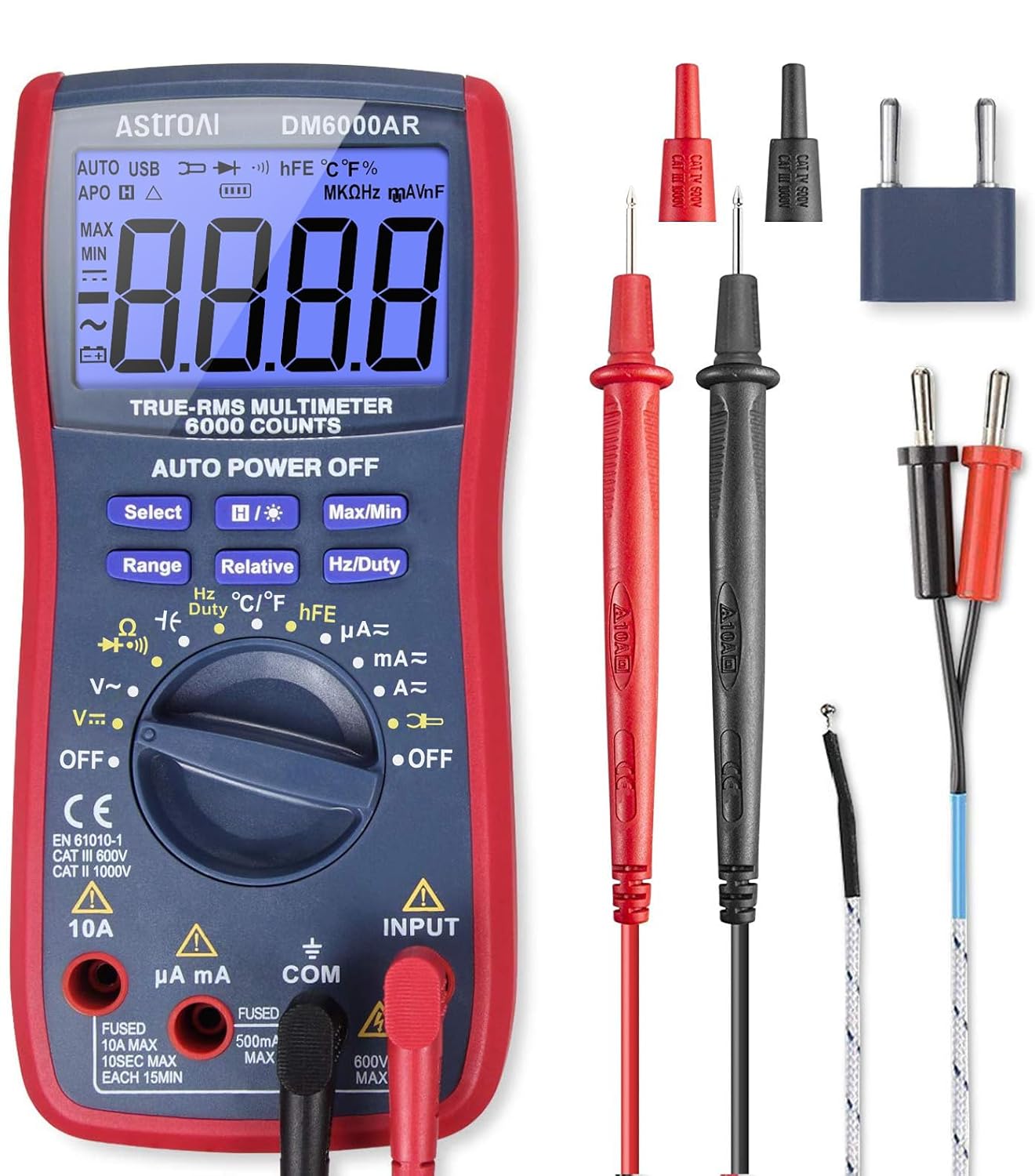
The DM6000AR is the meter that made "cheap multimeter" stop meaning "bad multimeter." It ships with true-RMS measurement and a 6000-count display — both specs you would have paid three figures for a decade ago — at a price that sits comfortably under most brand-name voltage testers.
True RMS at this price is the headline. Plug an averaging meter into a circuit feeding a dimmer or an LED driver and it will happily report a voltage that is 10-15% off. The DM6000AR reads the real value. For a homeowner diagnosing why a dimmer buzzes or why an LED fixture flickers, that is the difference between a diagnosis and a guess.
The compromises are where you would expect them. AstroAI publishes no drop rating for the case at all, where Klein prints one on the box, so this wants a tool bag rather than a back pocket. And the safety marking on the body is worth reading before you assume it matches the others: it says EN 61010-1, CAT III 600V, CAT II 1000V — the CAT III number matches the Klein and the Fluke, which is the number that counts at a panel.
The 6000-count display deserves a note, because the number is easy to misread as a marketing figure. Counts describe resolution, not accuracy: a 6000-count meter can show 599.9 before it has to jump to the next range, where a 4000-count meter switches at 399.9. In practice this means finer readings on low-resistance measurements — checking a heating element or a motor winding, where the difference between 1.2 and 1.8 ohms tells you whether the part is dead.
Two things the DM6000AR does that pricier meters often skip: there is an hFE transistor-test position on the dial, and it ships with a K-type thermocouple for surface temperature readings. Neither is essential for house wiring. Both are useful the first time you find yourself wondering whether a breaker is running hot under load.
Both current inputs are fused — the body is printed FUSED 10A MAX and FUSED 500mA MAX — which is the single feature cheap meters skip and the one that turns a misplaced probe into an expensive noise rather than an injury.
Key Specs#
Safety Rating : CAT III 600V
Ranging : Auto-ranging with manual override
True RMS : Yes, on both AC voltage and AC current
AC/DC Current : Up to 10A, both inputs fused; the body prints "10 SEC MAX EACH 15 MIN" on the 10A jack
Extras : Capacitance, frequency, duty cycle, temperature via included K-type thermocouple, diode, hFE transistor test
Display : 6000-count backlit LCD, with Data Hold, Relative and Max/Min
Drop Rating : None published
Bottom line#
Buy this if the meter will live in a drawer and come out four times a year — it gives up ruggedness and lead quality, not accuracy.
Fluke 117 — Best for Live Panel Work#
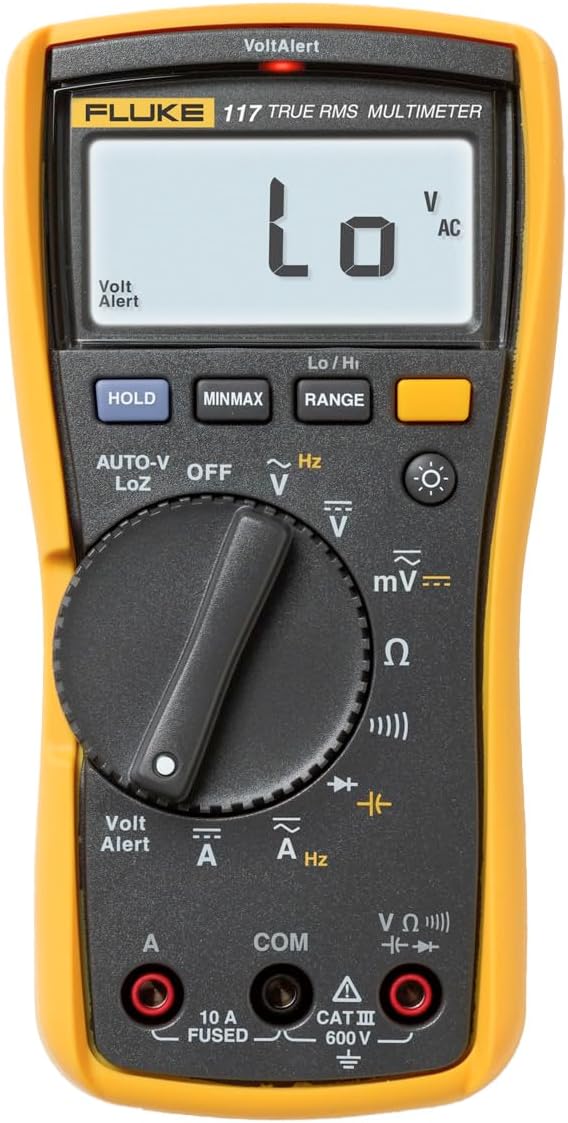
Two features move the Fluke 117 out of the "expensive Klein" category and into its own slot: VoltAlert and AutoV/LoZ. Both exist for the moment when you are standing at an open breaker panel and need to be certain.
VoltAlert is non-contact voltage detection built into the meter's nose. You wave the meter at a wire before you touch it — no second tool, no fumbling for a pen you left on the ladder. It is the "is this thing live" check integrated into the "what is this thing reading" tool.
AutoV/LoZ is the one that saves homeowners from a specific, maddening trap. Long unloaded runs of cable pick up induced voltage from neighbouring conductors, and a high-impedance meter will read 40 or 60 volts on a wire that is functionally dead. This is called ghost voltage, and it convinces people that a breaker did not work. LoZ mode drops the meter's input impedance, bleeds off the phantom charge, and reports zero. If you have ever stared at a meter reading 48V on a wire you know you killed, this feature is worth its price by itself.
There is a third feature that gets less attention and earns its keep: automatic AC/DC selection on the voltage range. The 117 looks at what is on the probes and decides for you. That sounds trivial until you are working through a mixed panel with a low-voltage thermostat transformer, a doorbell circuit, and 240V mains all within arm's reach, and every wrong dial position costs you thirty seconds and a moment of doubt about whether the reading you just took meant anything.
The rest of the meter is Fluke doing what Fluke does — a display you can read at arm's length in a dim basement and a three-year warranty behind it. What you give up: no temperature measurement at all, and a single current jack, so there is no separate milliamp range and no current measurement beyond the 10A the A jack handles. That is fine for a home and limiting on motors. It is genuinely more meter than most homeowners need.
Key Specs#
Safety Rating : CAT III 600V
Non-Contact Detection : VoltAlert, built into the meter body
Ghost Voltage Suppression : AutoV/LoZ low-impedance mode
True RMS : Yes
AC/DC Voltage : Up to 600V
AC/DC Current : Up to 10A on a single A jack, continuous, fused
Display : 6,000 counts, updating 4 times a second, with a 33-segment bar graph
Fuse : 11 A, 1000 V fast fuse on the A input
Size and Weight : 167 x 84 x 46 mm, 550 g
Warranty : 3 years
Bottom line#
If your work involves opening the breaker panel rather than just the outlet box, the Fluke's ghost-voltage handling and integrated VoltAlert are not luxuries.
Which one should you buy?#
If you want one meter and do not want to think about it again, buy the Klein MM420. It is auto-ranging, it is true RMS, it is CAT III 600V, it survives a 2-metre drop, and it handles capacitance so you can test appliance and HVAC parts. For the overwhelming majority of home electrical work — outlets, switches, breakers, thermostat wiring, dryer circuits — it is the correct answer and the reason it sits at the top of this list.
If the meter is going to spend most of its life in a drawer, buy the AstroAI DM6000AR. Occasional users do not benefit from a drop rating, and they do benefit enormously from true-RMS accuracy. Buying the professional meter for a tool you touch twice a year is not thrift, it is decoration.
If you work at the panel, buy the Fluke 117. Ghost voltage is not a theoretical problem — it is the single most common way a homeowner concludes a wire is dead when it is not, or panics over a wire that is. LoZ mode ends the argument, and VoltAlert means the "is it live" check happens with the tool already in your hand.
One thing all three share: none of them replaces turning the breaker off and verifying with the meter that you turned off the right one. The meter is how you check your work, not how you avoid doing it.
Pros & Cons#
Pros:
- Covers every tier from an occasional-use drawer meter to a professional panel meter
- Every pick carries a CAT III 600V rating and reads true RMS
- Explains true RMS and ghost voltage, so the spec sheet actually means something
- Fused current jacks on every pick, the safety feature cheap meters skip
- The Klein and the AstroAI both ship with a K-type thermocouple, so appliance and HVAC diagnosis is covered out of the box
- Only the Fluke offers AutoV/LoZ and integrated VoltAlert, and the list says plainly who needs them
Cons:
- Availability and pricing move; verify at click-through
- Specs may change across product generations
- None of these replaces a clamp meter for high-current automotive work
- AstroAI publishes no drop rating, so the budget pick is the one to keep in a bag
- Amazon US carries the Klein MM420 only as a bundle with a magnetic hanger, not on its own
FAQ#
Do I need true RMS for basic home electrical work?#
For checking whether an outlet has 120V, no — an averaging meter reads sinusoidal utility power correctly. You need true RMS the moment you measure downstream of a dimmer, an LED driver, a variable-speed motor, or a switching power supply, because those chop the waveform and averaging meters overstate or understate the result by 10% or more. All three picks here include it, so there is little reason to buy a meter without it.
What does CAT III 600V actually mean, and why does it matter at home?#
The CAT rating describes how much transient energy the meter can absorb without the arc reaching your hand. CAT II covers appliances plugged into an outlet; CAT III covers the fixed wiring behind it — breaker panels, hardwired circuits, distribution wiring. Home breaker panels sit in CAT III territory because there is far more fault energy available closer to the service entrance. All three meters here are CAT III 600V rated. A CAT II-only meter at a panel is the classic way people get hurt.
Is the Fluke 117 worth its premium over the AstroAI?#
It depends entirely on whether you open the breaker panel. If your work stops at the outlet box, the AstroAI measures the same voltage just as accurately and the Fluke's premium buys you durability you may never cash in. If you work at the panel, AutoV/LoZ eliminates ghost-voltage misreadings and integrated VoltAlert removes a whole tool from the process. Both are safety features, not conveniences, and that changes the arithmetic.
Can any of these test a car battery or automotive circuits?#
Yes. All three read DC voltage and DC current, which covers battery voltage, alternator output, and parasitic draw testing. The AstroAI is the common choice for this because a garage meter takes abuse and gets replaced. Note that none of these will measure the hundreds of amps a starter motor pulls — that needs a clamp meter, which is a different tool entirely.
What is ghost voltage and will a cheaper meter fool me?#
Ghost voltage is induced voltage that a long, unloaded conductor picks up from a live wire running alongside it. A high-impedance digital meter draws almost no current, so it displays that induced charge as a real reading — often 30 to 80 volts on a wire that is genuinely disconnected. The Klein and the AstroAI will both show it. Only the Fluke's LoZ mode actively drains it and reports the true zero. The workaround on the other two is to load the circuit or confirm with a solenoid tester.
Should I replace the test leads that come in the box?#
Not for the rating. The AstroAI's supplied probe caps are printed CAT IV 600V / CAT III 1000V, which meets or beats the meter itself, and the Klein and Fluke leads are fine as shipped. The rule to remember is the general one: the leads must carry a CAT rating at least as high as the meter's, because a CAT III meter with CAT II leads is a CAT II system, and the rating that protects you is always the lowest one in the chain.