

Who it's for#
Most people should not buy the Shargeek 300, and that is the honest starting point. It is a niche tool wearing a spectacular outfit.
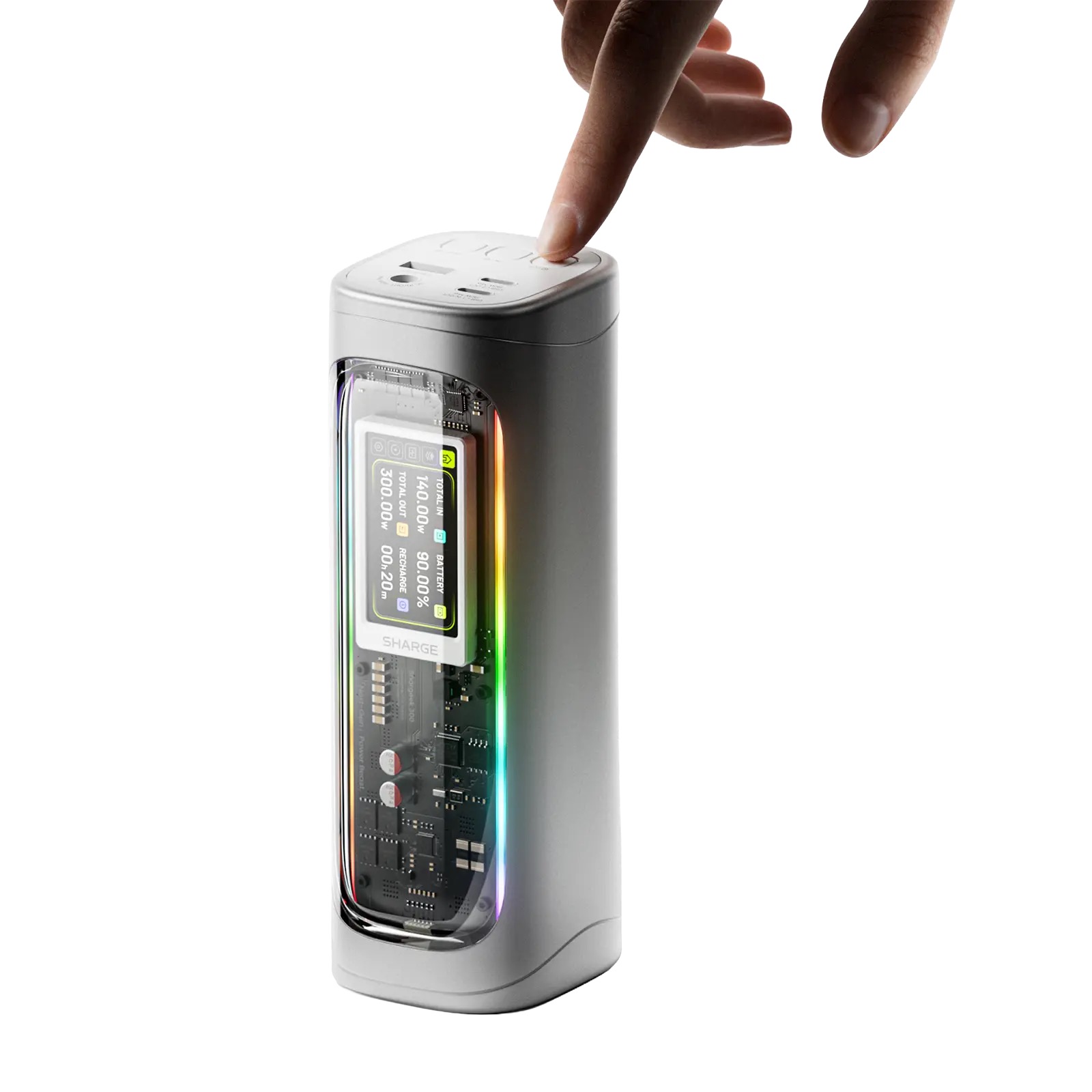
You buy it for three things the spec sheet gives you and almost nothing else does: the adjustable 5-28V DC barrel output, the 1.9-inch display that turns power delivery into something you can actually watch, and a transparent case that looks unlike any other battery on sale. If those three things make you lean forward, and you are willing to carry 750g in your bag to have them, this is your power bank. If they do not, keep reading, because the section below is going to talk you out of it.
Perfect for:
- Tinkerers and field techs who need to feed a laptop, a router, an amateur-radio rig or an older DC-barrel device that no USB-C bank can drive
- Gear enthusiasts who genuinely enjoy the transparent CNC build and want the "skeleton watch" of power banks on their desk
- Data-curious travellers who want the 1.9-inch display reporting live watts rather than guessing at a four-LED gauge
- Two-laptop workers who occasionally need 280W across both USB-C ports at the same time
If you only carry a phone and a Switch, or you buy on value, you are not in this list.
If you are in it, check the current price: View on Amazon
What it does that nothing else does#
This is the honest case for the Shargeek 300, and it rests on exactly two features.
The adjustable 5-28V DC barrel output#
Alongside its USB-C ports, the Shargeek 300 has a variable DC barrel output you can set anywhere from 5V to 28V at up to 5A. No mainstream USB-C power bank offers this. It means you can run gear that expects a fixed DC input — routers, some monitors, ham-radio equipment, older laptops with barrel jacks, DC-powered lighting — directly from the bank without hunting for a trigger cable or a lossy adapter. For the person who actually needs it, this is the whole reason the bank exists, and it is a real, verifiable capability the competition does not match.
The 1.9-inch IPS display#
The Shargeek 300's 1.9-inch IPS screen shows live input and output wattage, remaining capacity and per-port status. Most power banks give you four LEDs and a shrug. Here you can see, in the moment, whether a port is negotiating 140W or falling back to something slower, and roughly how long you have left. On a bank that can push 300W into two laptops, that feedback is genuinely useful rather than decorative — you can tell at a glance if a cheap cable is bottlenecking your charge.
Everything else the Shargeek 300 does — 300W total, dual 140W USB-C, 140W input — is excellent but not unique. Anker, Ugreen and others hit similar USB-C numbers. The DC port and the display are the two things you are actually paying the premium for.
Where it loses#
A review that only praised this bank would be useless. Here is where the Shargeek 300 is beaten.
It is the heaviest in its class. At 750g, the Shargeek 300 is a brick. The Anker Prime 27,650mAh 250W weighs 665g — the Shargeek is about 85g heavier while holding less energy. You feel 750g in a bag all day, and for many buyers that alone ends the conversation.
It carries less airline-legal capacity than the Anker. This is the one that matters. The Shargeek 300 stores 86.4Wh. The Anker Prime 250W stores 99.54Wh — 13.14Wh more usable energy that still clears the 100Wh airline limit. If your priority is the most airline-legal capacity you can carry, the Anker simply wins, and it is not close.
The RGB is cosmetic and does nothing. The Shargeek 300 has dual RGB light bars. They look good in a dark room. They do not tell you anything the display doesn't already say, they don't improve charging, and they draw a trickle of power to exist. Treat them as decoration, because that is all they are.
Nobody outside Sharge has tested it. No independent teardown, lab test or sustained-load measurement of the Shargeek 300 has been published. That means the thermal and speed figures below are Sharge's own numbers, not something a reviewer has verified. That is not an accusation — it is a fact you should weigh before you buy.
Airline rules#
Good news, and it is simple. At 86.4Wh, the Shargeek 300 sits comfortably under the 100Wh limit airlines enforce for lithium batteries in the cabin. You do not need airline approval to bring it, and there is no paperwork.
Two rules still apply, and they apply to every lithium power bank, not just this one:
- Carry-on only. Lithium batteries are banned from checked luggage. The Shargeek 300 travels in your cabin bag or it does not travel.
- Terminals protected. Keep it from short-circuiting against keys or coins — its own case handles this, but the principle holds.
For context, the Anker Prime 250W at 99.54Wh is also under the limit, just with less headroom. Both are cabin-legal. Neither can go in the hold.
Will it charge a Switch 2?#
Here is the honest answer, and it comes with a caveat you should read before the answer.
Neither Sharge nor any reviewer has connected this power bank to a Nintendo Switch 2. What we can say is drawn from port specifications, not from a test. The Shargeek 300's 140W USB-C ports easily exceed the roughly 20W a Switch 2 draws in handheld mode — so as a matter of capability, yes, it will charge and run the console with enormous headroom to spare. But that is inference from the port specs, not an advertised or certified feature. Sharge does not market the Shargeek 300 as Switch 2 compatible, and you should not read one into it.
And frankly, a 750g power bank is the wrong tool for a 20W handheld. You would be carrying a two-laptop battery to feed a device that a bank a third of the weight would charge just as well. The only reason this pairing makes sense is if you already carry the Shargeek 300 for your laptop, and topping up the Switch is a free bonus on a bank you were bringing anyway.
If the Switch 2 is your main device, look at our best Nintendo Switch 2 accessories guide, where lighter, cheaper banks fit the job far better.
Key Specs#
Total output : 300W across all ports combined
USB-C ports : Two ports, up to 140W each
USB-A port : Up to 20W
Adjustable DC barrel output : 5-28V variable, up to 5A
Capacity : 24,000mAh / 86.4Wh
Input : Up to 140W USB-C
Display : 1.9-inch IPS screen (live watts, capacity, per-port status)
Lighting : Dual RGB light bars (cosmetic)
Recharge time : 44 minutes to full, per Sharge (manufacturer claim, not independently measured)
Sustained output : 280W sustained, per Sharge (manufacturer claim)
Weight : 750g
Airline status : 86.4Wh, under the 100Wh cabin limit — carry-on only
Ready to buy it for the DC port and the display? Check current availability: View on Amazon
How it compares#
Rather than a table that breaks on a phone, here is how the Shargeek 300 stacks against three banks we have already reviewed. The short version: it wins on the DC port and the display, and loses on weight and airline-legal capacity.
Versus the Shargeek 170#
The Shargeek 170 is the same 24,000mAh / 86.4Wh cell in a lighter, cheaper, IP66-rated body, capped at 170W total with a single 140W USB-C port. The Shargeek 300 nearly doubles total output to 300W, adds a second 140W port so you can charge two laptops at once, and adds the adjustable DC barrel output the 170 does not have. You pay for that in weight and price. If you never need to charge two laptops simultaneously and don't need the DC port, the 170 is the smarter buy from the same family.
Versus the Anker Prime 250W#
This is the comparison that should decide it for most people. The Anker Prime 27,650mAh 250W holds 99.54Wh — 13.14Wh more usable energy than the Shargeek's 86.4Wh, still airline-legal — weighs 665g against the Shargeek's 750g. On raw value, more capacity for less weight, the Anker wins outright. The Shargeek answers with the one thing the Anker has no reply to: the adjustable DC barrel output, plus the bigger display and the transparent case. If you don't need those, buy the Anker.
Pros & Cons#
Pros:
- 300W total output charges two 16-inch MacBook Pros and a phone at once
- Adjustable 5-28V DC barrel output runs gear no rival power bank can
- 1.9-inch IPS display reports live watts, capacity and per-port status
- 86.4Wh keeps it under the 100Wh airline carry-on limit
- Transparent CNC-aluminium body is genuinely unlike anything else on sale
- 140W input means a fast top-up between flights
Cons:
- At 750g it is the heaviest power bank in its class — about 85g more than the Anker Prime 250W
- Carries less airline-legal capacity than the Anker Prime 250W (86.4Wh vs 99.54Wh)
- The RGB lighting is purely cosmetic and adds nothing functional
- No independent teardown or sustained-load testing exists yet; the thermal and recharge figures are Sharge's own
- You pay a premium for a battery you will notice in your bag
Final Verdict#
Buy it only for what makes it unique. The Shargeek 300 is worth it if the adjustable DC barrel output, the 1.9-inch display or the transparent case is the specific thing you came for — those are real, and nothing else in the class matches all three. Skip it if you are buying on value: the Anker Prime 250W gives you more airline-legal capacity in a lighter body, and for most people that is the better battery.
Our recommendation: Be honest with yourself about the DC port. If you cannot name a device you would plug into it, you are paying a weight-and-price premium for a display and some looks — and the Anker is the smarter buy. If you can name that device, this is the one battery that will drive it: View on Amazon
FAQ#
Can I take the Shargeek 300 on a plane?
Yes. At 86.4Wh it sits under the 100Wh carry-on limit airlines enforce, so no special approval is needed. Like every lithium battery it must travel in your carry-on, never checked luggage.
Shargeek 300 or Anker Prime 250W?
The Anker carries more airline-legal capacity (99.54Wh vs 86.4Wh) in a lighter body, so it wins on value. The Shargeek wins only if you need the adjustable DC barrel output or want the display and the transparent case.
Will it charge a Nintendo Switch 2?
By its port specs, easily — its 140W USB-C ports far exceed the roughly 20W a Switch 2 draws in handheld mode. But nobody has actually tested this pairing, Sharge does not advertise Switch 2 compatibility, and a 750g power bank is far more than a handheld console needs.
Does it really recharge in 44 minutes?
That 44-minute figure at 140W input is Sharge's own claim, not an independently measured result. No teardown or lab test of the Shargeek 300 has been published yet, so treat the recharge, thermal and 280W sustained-output numbers as manufacturer claims until reviewers verify them.