

At a Glance#
Product : Mysa Smart Thermostat for Electric Baseboard Heaters (V2)
Brand : Mysa
Best For : Homeowners and renters with electric baseboard, fan-forced, or convector heat who want smart scheduling and energy tracking
Protocol : WiFi 2.4GHz + Bluetooth LE (HomeKit, Alexa, Google Home)
Buy Now : View on Amazon
Key Highlights:
- Line-voltage design handles 120V-240V heaters up to 16 amps that standard smart thermostats can't control
- Native Apple HomeKit, Amazon Alexa, and Google Home support for voice and automation
- Custom weekly scheduling plus geofencing that lowers the heat when you leave
- Built-in current and voltage sensors give real per-room energy monitoring
- Mysa's supported list also covers self-contained hydronic baseboard and radiant ceiling heat
Who Should Buy This#
The Mysa hits a sweet spot for people stuck with electric baseboard heat who thought smart thermostats weren't an option. Most smart thermostats only work with central, low-voltage HVAC systems. Mysa is engineered for high-voltage resistive heat, delivering scheduling, remote control, and energy insights that generic line-voltage dial thermostats simply can't.
Perfect for:
- Apartment and condo owners who heat with baseboards and want to stop paying to warm empty rooms all day
- Cold-climate homeowners who need per-room temperature control to keep bedrooms cool and living spaces warm on a schedule
- Smart-home enthusiasts who want their heaters inside HomeKit, Alexa, or Google routines alongside lights and locks
- Budget-minded renters looking to cut electric heating bills without replacing the heaters themselves
Design & Build Quality#
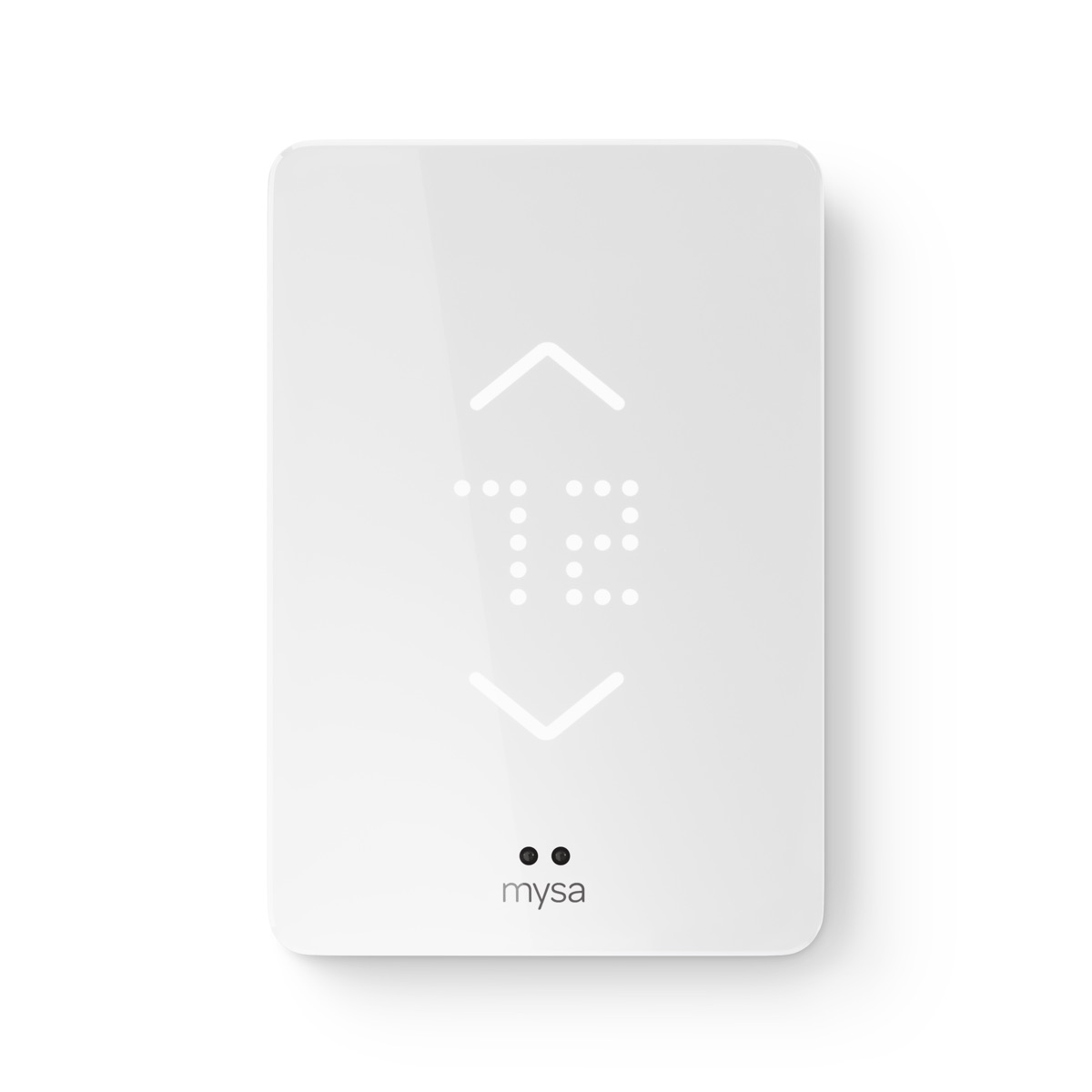
The Mysa is a clean upright white panel with an LED display that wakes as you approach, thanks to a built-in proximity sensor - Mysa calls the behavior Sleep and Wake on Approach. At 5.1 inches tall and 3.5 inches wide (129 x 88 mm) and 0.8 inches deep, it covers the footprint of an old thermostat and mounts into a standard-size gang box. The minimalist face shows the current temperature - Mysa specifies only an "LED display with touch buttons" - and disappears into a wall far more gracefully than the beige mechanical dials it replaces.
Touch buttons handle up and down temperature adjustments directly on the unit, so the thermostat still works even if your WiFi drops or your phone is dead. It comes in white or black to match either light or dark walls.
Key Features#
Built for Electric Baseboard Heat#
This is the headline feature: the Mysa is a line-voltage thermostat, not a low-voltage one. It switches high-voltage power to the heater directly, and Mysa publishes the ceiling as three separate figures - "Max Load: 16 Amps", "3,800 Watts @ 240V" and "1,900 Watts @ 120V" - across "most high voltage (120V - 240V) electric heating systems". It wants a 20A breaker. It replaces most single-pole and double-pole baseboard thermostats, with one wiring nuance Mysa states outright: "it functions internally as a single-pole device", requiring a connection to both power wires while switching the heater on only one of them.
Mysa's supported list runs wider than baseboards alone: electric baseboard, electric fan-forced (convector), self-contained hydronic baseboard, and radiant ceiling. These are the systems Nest and ecobee cannot control. What Mysa explicitly rules out is low-voltage 24V equipment (central furnaces, central air, heat pumps), millivolt gas fireplaces, central hydronic systems running off a boiler, and electric in-floor heat, which needs Mysa's separate in-floor model. If you have baseboards, this is one of the very few genuinely smart options available.
Scheduling and Geofencing That Cut Bills#
You build a schedule in the app - Mysa's own words are "custom scheduling" and "create weekly schedules", not a fixed set of periods - and layer geofencing on top. Mysa describes that half plainly: "geofencing detects when you leave to lower the heat automatically", alongside an Auto Home / Away Temperature feature. It does not publish a pre-heat-before-you-arrive behaviour, so do not buy it expecting arrival prediction.
For baseboard heat, which is expensive to run around the clock, this is where the savings live. Mysa's headline claim is to "save up to 26% on heating bills" - though the same page also tells you "You save 15-26% on heating costs" in one place and that it "can help you save up to 20% on heating costs" in another, so read 26 as the top of a range rather than the expected result. Real savings depend on your rates and habits, but even trimming overnight and away-from-home hours adds up fast across a winter.
Real Energy Monitoring, Not Guesswork#
Because the Mysa has built-in current and voltage sensors, it measures actual electricity use at each heater rather than estimating. The app delivers real-time usage and a monthly energy report per room, so you can see exactly which heater is driving your bill.
That visibility turns vague "my heating is expensive" frustration into specific action. You might discover one bedroom heater running far more than expected and fix the schedule in seconds. Track your usage anytime: View on Amazon
Full Smart-Home Integration#
The Mysa works natively with Apple HomeKit, Amazon Alexa, and Google Home. You can raise the temperature by voice, include heaters in scenes like "Good Night," and automate them alongside lights, locks, and sensors. It connects over 2.4GHz WiFi, with Bluetooth Low Energy listed alongside it.
Multi-home management and shared app access mean couples, families, or a landlord managing multiple units can all control the same thermostats without friction.
Technical Specifications#
Model : Mysa for Baseboards V2 (BB.2.0.01.NA-US)
Voltage Compatibility : 120V to 240V AC line voltage
Maximum Load : 16 amps; 1,900W at 120V, 3,800W at 240V
Breaker : Install on a 20A breaker
Minimum Load : 250W (the V2; the Baseboard LITE has none)
Heater Types : Electric baseboard, electric fan-forced (convector), self-contained hydronic baseboard, radiant ceiling
Not Compatible : Low-voltage 24V systems (central furnace, central air, heat pumps), millivolt gas fireplaces, central hydronic (boiler) systems, electric in-floor heating
Wiring : Requires a neutral or L2 wire; Mysa's spec says "3-4 wires total" while its own FAQ and the Amazon listing both say you typically need four; replaces single-pole and double-pole thermostats
Display : LED display with touch buttons for up/down temperature control
Connectivity : WiFi 2.4GHz (802.11 b/g/n) plus Bluetooth Low Energy
Smart Platforms : Apple HomeKit, Amazon Alexa, Google Home
Sensors : Temperature (±0.5°F / ±0.3°C), humidity (±2%), current, voltage, light, and proximity
Dimensions : 5.1 x 3.5 x 0.8 inches (129 x 88 x 20 mm), fits a standard-size gang box
Certification : UL 60730
Colors : White or black
Warranty : 5-year manufacturer warranty
Pros & Cons#
Pros:
- Purpose-built for 120V-240V electric baseboard, fan-forced, and convector heaters that most smart thermostats can't touch
- Works natively with Apple HomeKit, Amazon Alexa, and Google Home for voice and automation control
- Custom weekly scheduling plus geofencing that drops the heat automatically when you leave
- Built-in current and voltage sensors deliver real per-room energy monitoring and monthly reports
- LED touch display looks clean on the wall and fits a standard-size gang box
- Manufacturer claims up to 26% heating savings, backed by a 5-year warranty
Cons:
- Needs both power wires (L1 and L2/neutral) and typically four wires in the box; a two-wire switch loop cannot run it without rewiring
- One thermostat controls one heater circuit, so whole-home coverage means buying several units
- 2.4GHz WiFi only, no 5GHz band support
- Rules out low-voltage 24V central HVAC and heat pumps, millivolt gas fireplaces, central boiler hydronic, and electric in-floor heat
- Wants a 20A breaker and a minimum 250W load, so a very small heater may fall under the floor
FAQ#
Does the Mysa work with my electric baseboard heater?
Yes, if your heater is line-voltage electric (120V to 240V) baseboard, electric fan-forced (convector), self-contained hydronic baseboard, or radiant ceiling, within Mysa's ceiling of 16 amps (3,800W at 240V, 1,900W at 120V) and above its 250W minimum load. It replaces most single-pole and double-pole line-voltage thermostats.
Do I need a C-wire or neutral wire to install Mysa?
Not a C-wire - that is a low-voltage central-HVAC part. Mysa needs a connection to both live wires in the box (L1 and L2/neutral) to power itself, which means 3 to 4 wires. Mysa's own answer is blunt about the exception: "If you only have two wires, it is a switch loop and Mysa will not work without rewiring." Count the wires in the junction box rather than the ones landed on your old thermostat, because Mysa says fewer than 10% of installations really have only two.
Can I control the Mysa with Apple HomeKit, Alexa, or Google?
Yes. Mysa supports Apple HomeKit, Amazon Alexa, and Google Home natively, so you can adjust temperature by voice, include it in scenes, and automate it alongside other smart devices over 2.4GHz WiFi.
How much can the Mysa Smart Thermostat save on heating?
Mysa's headline is "save up to 26% on heating bills" through smart scheduling, geofencing and eco automation, though the same page elsewhere says "You save 15-26% on heating costs" and "up to 20%". Actual savings depend on your climate, rates, and habits, but the built-in energy reports let you track real usage per room.
Can it go on a GFCI breaker?
Mysa's answer is that "Mysa for Baseboard is generally compatible with GFCI breakers" - the caution it publishes is for its in-floor model, which has its own GFCI protection and should not sit behind a GFCI breaker.
Final Verdict#
Buy it. If you heat with electric baseboards, the Mysa is the rare smart thermostat actually engineered for line-voltage heat, and it delivers the scheduling, energy tracking, and smart-home control that make those old heaters finally efficient.
Our recommendation: Start with the rooms you use most, like bedrooms and the living room, where scheduling savings are largest, then add units as budget allows. Check current availability: View on Amazon