

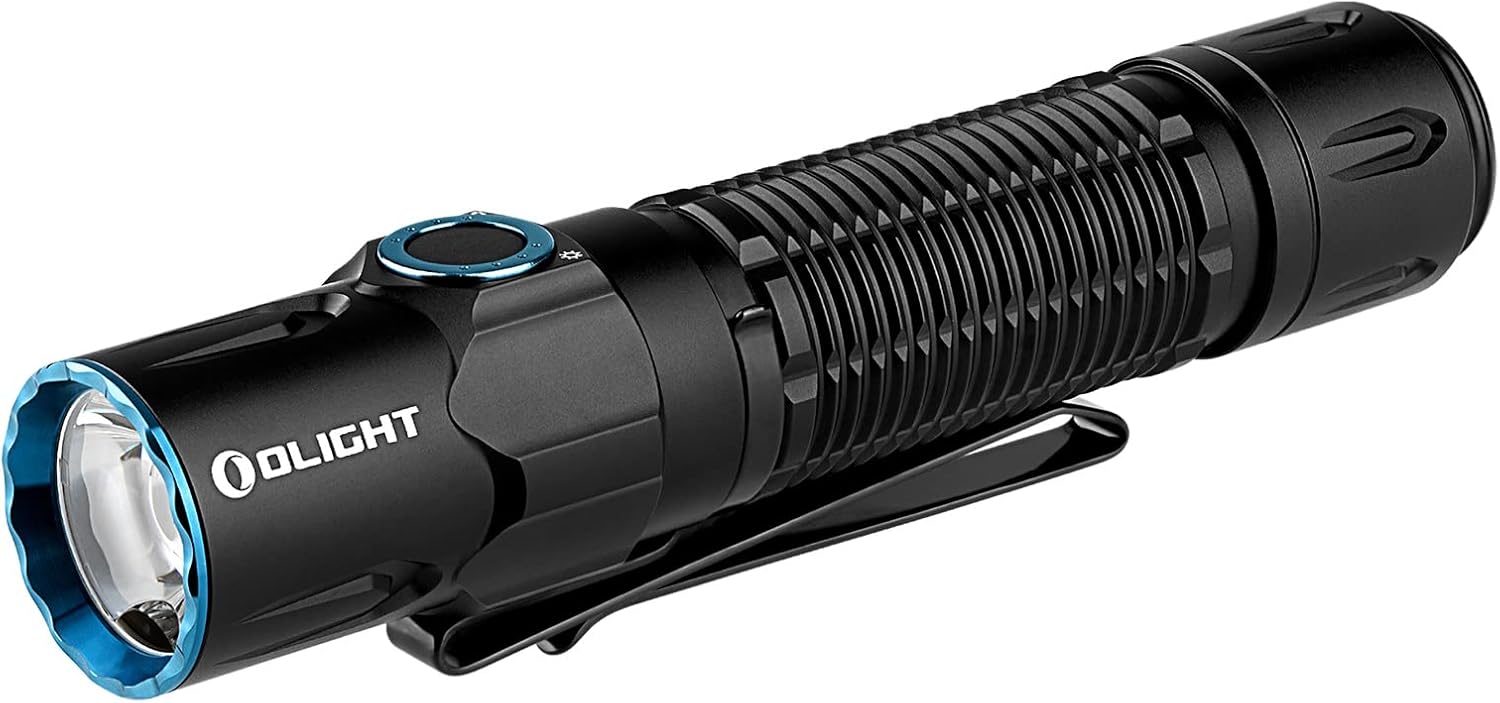
The Olight Warrior 3S is our top pick for everyday defense — 2,300 lumens with a dual-switch interface, magnetic charging, and a tactical tail switch ready for instant strike-mode access. The Streamlight ProTac 2AA-X wins on field reliability with universal AA batteries and a proven aluminum body that runs anywhere. The Fenix PD36R ACE delivers the longest reach with a 415-meter throw for identifying threats at distance.
Who This Comparison Is For#
- Concealed-carry holders and home-defense planners who want a tactical light that pairs with a pistol or stays bedside, ready to identify and disorient a threat in the dark
- Security and law enforcement off-duty users who carry a duty light and want a lower-profile backup that still hits hard
- Outdoor and travel users in rural, off-grid, or unfamiliar environments where a high-output light doubles as a deterrent and a navigation tool
How We Picked#
- Real defensive output: Every pick reaches at least 270 lumens on its primary high mode and the two rechargeable picks go well past 2,000 — enough to disorient at close range and overwhelm dark-adapted vision
- Tactical tail-switch ergonomics: Each light offers an instant momentary-on switch for high output without cycling through low modes — critical when seconds matter
- Robust impact and water rating: IPX7 as the floor and IPX8 or IP68 on the two rechargeables, in machined aluminum bodies — Streamlight publishes a 2-metre impact test, Olight 1.5 metres and Fenix a 1-metre drop test
- Established platforms: Every pick comes from a line with a long duty record, rather than a brand-new design from an unknown maker
- Three charging philosophies: A magnetic proprietary cable, universal AA cells you can buy anywhere, and a built-in USB-C port — covering every charging or stocking preference
Olight Warrior 3S — Best Overall#
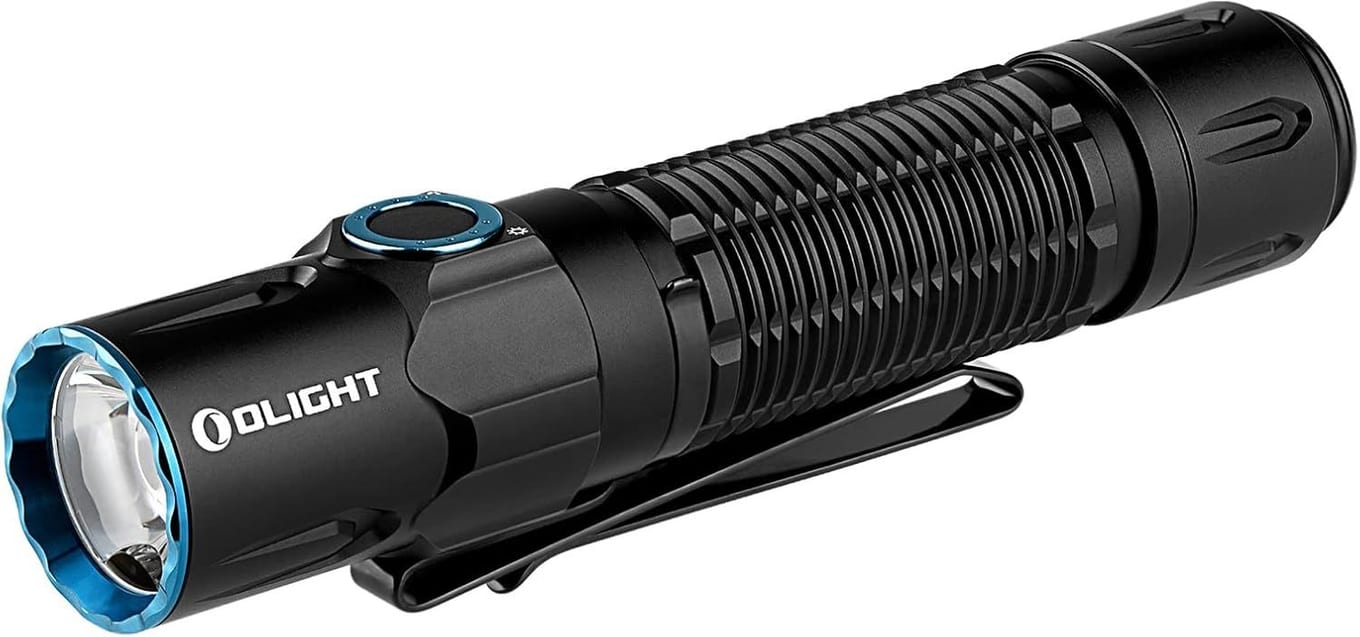
The Olight Warrior 3S is the closest thing to a turnkey defensive light on the market. It pumps 2,300 lumens out of a 21700 cell that ships pre-installed, charges via Olight's proprietary magnetic MCC3 cable, and runs a dual-switch interface — a tactical tail button for instant momentary high, plus a side e-switch for everything else. That separation matters under stress. You don't fumble through modes when you need light right now.
Olight rates the beam at 300 metres from a TIR optic lens with a peak intensity of 23,000 candela, which means you can identify a threat at the end of a hallway and still see what's on either side. The two-stage tactical tail switch is the part that matters under stress, though check which program yours is on: Olight's factory default gives Medium on a half press and Turbo on a hard press, and you have to switch to its second configuration to put Strobe on the tail. A nylon holster is in the box, and the magnetic charging interface means no exposed USB port to corrode in pocket lint — Olight is explicit that there is no USB-C direct charging on this light, so the MCC3 cable is not optional.
One behaviour to know about before you rely on it: the Warrior 3S has a built-in proximity sensor that drops the brightness when something is close to the head at level 3 and above, so Medium, High, Turbo and Strobe. That protects your gear and your hand, but it also means the light will dim itself if you hold it up against a surface. Olight notes it can be disabled by double-pressing the side switch within five seconds of the auto-dimming.
For a deeper dive on the Warrior 3S interface and beam, read our full Olight Warrior 3S review.
Key Specs#
Max Output : 2,300 lumens (Turbo) / 800 lumens (High) / 200 lumens (Medium) / 15 lumens (Low) / 1 lumen (Moonlight)
Beam Distance : 300 meters (23,000 candela peak)
Battery : Olight 21700 5,000mAh Li-ion (included), magnetic MCC3 charging
Runtime : 55 days (Moonlight) / 13 hours (Medium) / Turbo steps down after 2.5 minutes
Weight : 6.21 oz (176g) with battery
Size : 5.47 x 1.16 inches (139 x 29.5 mm)
Water Resistance : IPX8, with a 1.5 m impact rating in Olight's own ANSI/NEMA FL1 specification block
Switch : Two-stage tactical tail switch + side e-switch (mode control), with a proximity sensor that dims near objects
Bottom Line#
The most thought-out defensive light at this output level. Magnetic charging, a two-stage tactical tail switch straight to Turbo, and the longest published moonlight runtime here make it the easiest pick for everyday defense.
Streamlight ProTac 2AA-X — Best Budget#
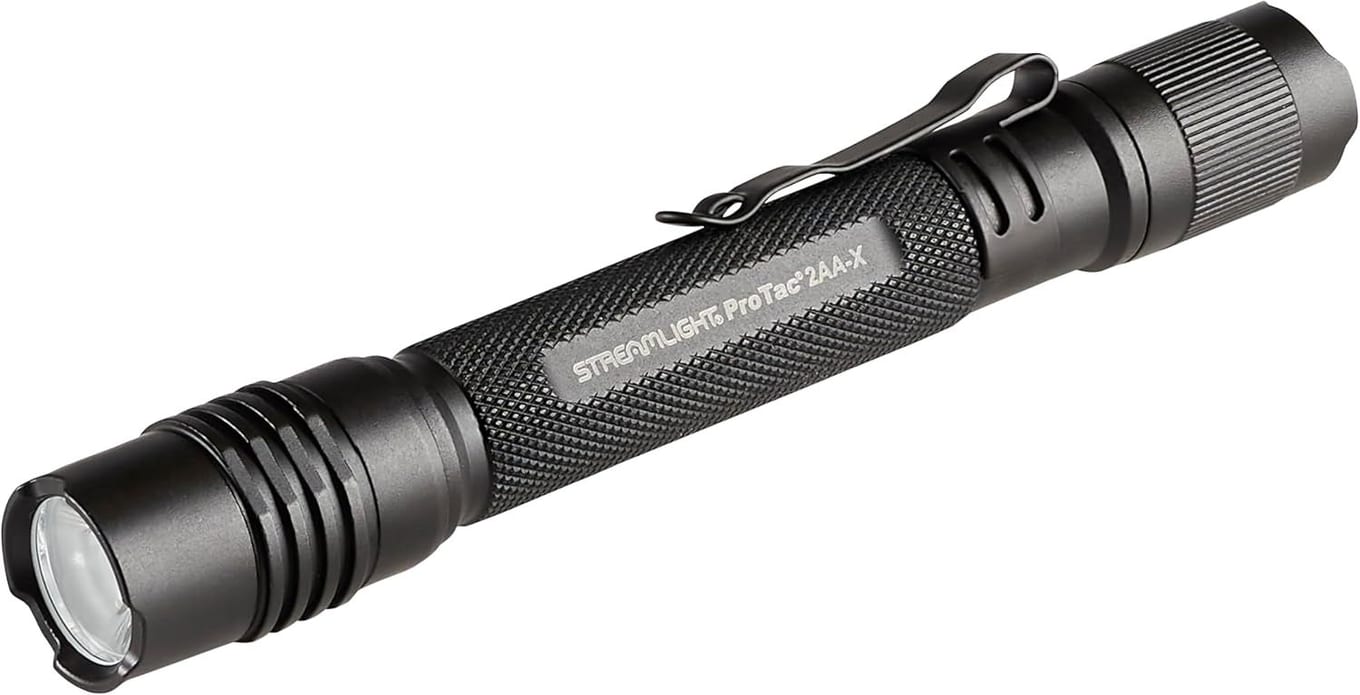
The Streamlight ProTac 2AA-X is the light you choose when you want zero excuses. It runs on two AA batteries you can buy at any gas station, in any country, in any disaster scenario — no proprietary cell to lose, no charger to forget on a trip. The machined aluminum ProTac body is a long-running Streamlight platform for duty belts and glove compartments, and it carries a limited lifetime warranty.
Output sits in defensive territory at peak high mode, with Streamlight's TEN-TAP programmable interface. The three programs are exactly these: High/Strobe/Low, which is the factory default; High Only; and Low/High. Streamlight calls the light multi-fuel because it accepts either two AA alkalines or the company's proprietary protected lithium-ion USB-C rechargeable pack, which is what takes it from 270 lumens to 550. The IPX7 rating handles rain, dunks, and washing-machine accidents, and Streamlight publishes a 2-metre impact-resistance test — the toughest figure of the three lights here.
The 2AA-X form factor is the sweet spot between a single-AA pocket light and a duty-sized 18650 — long enough for a Rogers-style flashlight grip with a pistol, short enough to ride in a back pocket all day without protruding. Anti-roll head and removable pocket clip round out the duty-ready feature set.
Wondering whether a multi-mode interface earns its extra clicks? Our page on what to look for in a flashlight covers mode order, momentary-on and why the interface decides more than raw output.
Key Specs#
Max Output : 270 lumens (High) on the included AA alkalines, 550 lumens on Streamlight's USB-C rechargeable pack (sold separately) — programmable TEN-TAP interface
Beam Distance : 203 meters (10,250 candela) on the rechargeable pack / 141 meters (5,000 candela) on alkaline AA
Battery : Multi-fuel: 2x AA alkaline (included) or Streamlight's proprietary protected lithium-ion USB-C rechargeable pack
Runtime : 2.5 hours (High) / 48 hours (Low) — alkaline AA
Weight : 3.5 oz (99g) with batteries
Size : 6.0 in (15.3 cm) long
Water Resistance : IPX7, waterproof to 1 metre; 2-metre impact resistance tested
Programmable Interface : TEN-TAP — High/Strobe/Low (factory default), High Only, or Low/High
Bottom Line#
The most universal, simplest defensive light here. Universal AA power makes it the right answer for travel, emergency kits, and anyone who hates proprietary batteries.
Fenix PD36R ACE — Best for Maximum Reach#
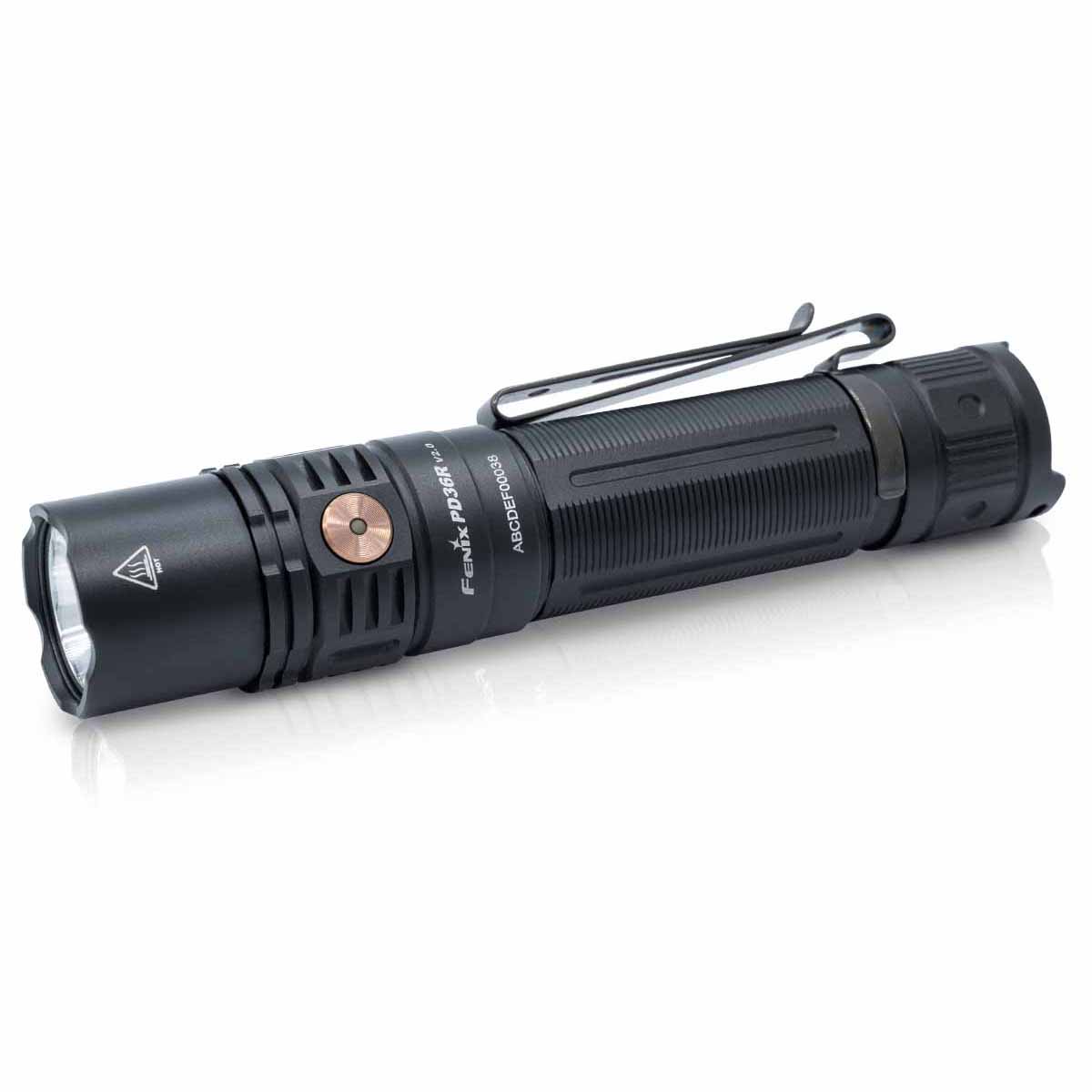
The Fenix PD36R ACE is the pick when you need to identify what's at the far end of the property, the parking lot, or the trail. With a 415-meter throw at 3,000 lumens, it pushes farther than the other two picks while staying in a duty-pocket-sized package. The 21700 cell charges via USB-C — no proprietary cradle, no missing cable on a trip.
What the ACE adds over the rest of the PD36 line is SET mode, a hidden switch under the neck that decides which modes the light cycles through at all. Option one gives you Turbo and nothing else. Option two gives Eco, Medium and Turbo. Option three unlocks all five brightness levels and is the only option that carries SOS. Strobe is on by default in all three options and can be switched off separately, by holding the SET switch for 1.2 seconds. It is the answer to the complaint that duty lights bury the mode you want behind presses you cannot count in the dark.
Build quality earns its duty reputation: an aluminum body with IP68 waterproofing, drop-tested to 1 metre, running a Luminus SFT70 Gen2 LED. The included 21700 ARB-L21-5000 V2.0 cell steps down rather than cutting out abruptly — which matters, because a light producing 3,000 lumens from this size body will not hold that figure for long.
For why sustained output matters more than the peak lumens on the box, see our page on what to look for in a flashlight.
Key Specs#
Max Output : 3,000 lumens (Turbo) / 1,000 lumens (High) / 350 lumens (Medium) / 150 lumens (Low) / 30 lumens (Eco); 63 h 25 min maximum runtime on Eco
Beam Distance : 415 meters
Battery : Fenix 21700 ARB-L21-5000 V2.0 5,000mAh Li-ion (included), USB-C rechargeable
Modes : Seven — five brightness levels plus Strobe and SOS, with SET mode to choose which of them the switch cycles
Weight : 6.41 oz (181.6 g) with battery
Size : 5.75 x 1.18 x 1.02 in (146 x 30 x 26 mm)
Water Resistance : IP68, drop-tested to 1 metre
Switch : Two-stage tactical tail switch, neck-mounted switch for output selection, and a hidden SET switch under the unscrewed neck for choosing the output group
Bottom Line#
The longest reach in this lineup with USB-C charging convenience. Pick this if your defensive scenarios extend past indoor distances.
Which One Should You Buy?#
If you want the easiest, most thought-out defensive light without juggling extra accessories, get the Olight Warrior 3S. The magnetic charging cable is a quality-of-life upgrade you'll notice every single time you top it off, and the tactical mode lockout means you can hand it to a family member without explaining a five-mode interface. For most everyday-defense scenarios, this is the pick.
If you live in cold weather, travel internationally, or build emergency kits where any battery shortage is unacceptable, get the Streamlight ProTac 2AA-X. AA batteries are the closest thing to universal currency in the battery world. Stockpile a pack of lithium AAs and the ProTac 2AA-X works in any temperature, in any country, after any disaster — no charger required.
If your defensive thinking includes long sight lines — large rural property, parking garages, hunting areas, or simply identifying what's moving down a long hallway — the Fenix PD36R ACE delivers the throw the other two can't match. The 415-meter beam distance puts targets in clear view at distances where the Warrior 3S and ProTac 2AA-X start washing out.
All three survive submersion and years of pocket carry, and all three publish an impact figure, though they do not track the water ratings: Streamlight lists a 2-metre impact test, Olight 1.5 metres for the Warrior 3S, and Fenix a 1-metre drop test. The right pick depends on whether you prioritize convenience (Olight), universal power (Streamlight), or reach (Fenix).
FAQ#
What makes a flashlight "tactical" versus a regular EDC light?#
Tactical lights are designed for defensive use — they prioritize a high-output momentary-on tail switch, a tight hotspot for target identification at distance, robust waterproofing, and an aluminum body that survives strike-impact use. EDC (everyday carry) lights prioritize size and convenience over raw output and switch ergonomics. All three picks here qualify as tactical because they pass the defensive-use threshold: instant high-output access, enough output to disorient at close range, and duty-grade construction.
Are a few hundred lumens enough for self-defense, or do I need 2,000+?#
A few hundred lumens is enough to disorient and identify in most defensive scenarios. The human eye's dark-adapted state is overwhelmed by anything above roughly 300 lumens at close range, so the marginal benefit of 2,300 lumens (Olight Warrior 3S) over the 270 to 550 of the Streamlight ProTac 2AA-X shows up at distance — identifying threats past 30 meters. Inside a home or close-quarters scenario, the smaller light performs much the same as the bigger one in practice.
Can I use these flashlights with a pistol for low-light shooting?#
All three are sized for a Rogers, Harries, or Surefire-style flashlight grip alongside a pistol. They are close enough in length that this is not the deciding factor: the Olight Warrior 3S is 5.47 in, the Fenix PD36R ACE is 5.75 in, and the Streamlight ProTac 2AA-X is 6.0 in — so the budget pick is actually the longest of the three, though at 3.5 oz it is also by far the lightest. None are weapon-mounted lights — for that you want a dedicated weapon light with rail mounting.
Are these flashlights legal to carry in checked or carry-on luggage?#
Yes for all three, with some restrictions. The Olight Warrior 3S and Fenix PD36R ACE both contain 21700 lithium-ion cells under the 100Wh airline limit, but you must remove the battery and carry it in your carry-on (lithium cells are prohibited in checked luggage by most airlines). The Streamlight ProTac 2AA-X uses standard AA batteries with no restrictions. Always verify current TSA and airline policies before flying.
How long do the rechargeable batteries last before they need replacing?#
Quality 21700 lithium-ion cells like the ones in the Olight Warrior 3S and Fenix PD36R ACE handle 500-1,000 charge cycles before noticeable capacity loss. For typical defensive-use patterns — a few minutes of use per day plus monthly full-discharge tests — these cells last roughly four to six years. The Streamlight ProTac 2AA-X has no built-in battery, so it lasts indefinitely with fresh AAs.
What's the difference between IPX7, IPX8, and IP68 waterproofing?#
IPX7 (Streamlight ProTac 2AA-X) means the light survives submersion to 1 meter for 30 minutes — splash, rain, and brief dunks are no problem. IPX8 (Olight Warrior 3S) means sustained submersion beyond 1 metre, to a depth the maker specifies. IP68 (Fenix PD36R ACE) adds dust-tight protection on top of IPX8 — meaningful for desert, jobsite, or sandy environments where fine particulate matters. For everyday defensive carry, all three ratings are more than sufficient. Impact ratings are a separate axis and they do not track the water ratings: Streamlight publishes a 2-metre impact test, Olight 1.5 metres for the Warrior 3S, and Fenix a 1-metre drop test.