

At a Glance#
The five decisions : Beam shape, what powers it, how long full brightness actually lasts, the interface, size and pocketability
The one most people get wrong : Buying on peak lumens — on a light pushing hard for its size, that figure is gone within about two minutes
The spec that matters instead : Sustained output — the brightness the light settles at once it warms up
The quiet dealbreaker : A user interface that needs three taps to reach the mode you want at 3am
Key Highlights:
- A tight beam throws far and lights nothing beside you; a wide beam does the opposite
- Peak lumens are a marketing sprint; sustained output is the number you live with
- Rechargeable is cheaper over time; AA is the one you can refuel in any petrol station
- Real pocket carry is decided by weight and clip, not by length
- A momentary-on tail switch matters more than an extra 200 lumens
Who This Is For#
Flashlight specifications are unusually adversarial: the headline number is chosen precisely because it flatters the product, and the numbers that predict satisfaction are further down the page.
Especially useful if you are:
- A first-time buyer who has noticed that lumen claims stopped meaning anything
- Someone who wants one light in a pocket every day and needs it to disappear
- Anyone buying for a car or a toolbox where batteries sit unused for months
- A shift worker or dog walker who needs the light to behave the same every night
1. Beam Shape Decides More Than Brightness#
Two lights with identical lumens can be useless at each other's jobs, because lumens measure total light output and say nothing about where it goes.
Throw is a tight, focused beam that reaches far. It picks out a fence at the end of a field, and it lights almost nothing to either side of you. It is what you want outdoors, on a property, or looking for something at distance.
Flood is a wide beam that lights everything nearby and reaches nowhere. It is what you want under a sink, inside an engine bay, or walking a path where the ground matters more than the horizon.
Most useful everyday lights sit between the two, and the practical question is which side of the middle they lean. A pocket light that only throws is frustrating for close work; a pure flood is frustrating outdoors.
Our recommendation: picture the last three times you actually needed a torch. If they were all within arm's reach, buy flood and ignore throw entirely. If the answer was "on a trail, in the dark, with both hands busy", the beam question is settled differently and you want a headlamp — see camping headlamps for backpacking.
2. What It Runs On#
This is the decision that determines whether the light works in a year, and it splits three ways.
Built-in rechargeable is now the default. USB-C in, no cells to buy, and the light is usually brighter because a lithium cell can deliver more current than an alkaline one. The catch is that when the battery finally degrades, you are often replacing the whole light — and if it is flat when you need it, there is nothing to swap in.
Removable rechargeable cells get you both: recharge normally, carry a spare for a long night.
Standard AA or AAA trades peak brightness for the ability to refuel anywhere on earth. For a glovebox or an emergency drawer that is a genuine advantage, because alkaline cells hold their charge for years in the packet while a light on a charger you forgot about does not. One caveat the packaging never mentions: alkaline cells left inside a device for years are a common way a stored torch is destroyed. The seal eventually vents and the electrolyte corrodes the battery tube and contacts. There is a real tension here — a glovebox light with the cells stored beside it is not a light you can grab — so the practical answers are to check it twice a year, or to use lithium AA primaries, which hold their charge for well over a decade and are far less prone to leaking.
The Streamlight ProTac 2AA-X takes the flexible route deliberately — it is built to run on more than one cell type, so it can live on cheap AAs and still take a lithium-ion pack when you want the output. Note that the pack is a proprietary Streamlight USB-C unit sold separately, not an off-the-shelf lithium AA; on alkalines the light does 270 lumens, on the pack 550: View on Amazon
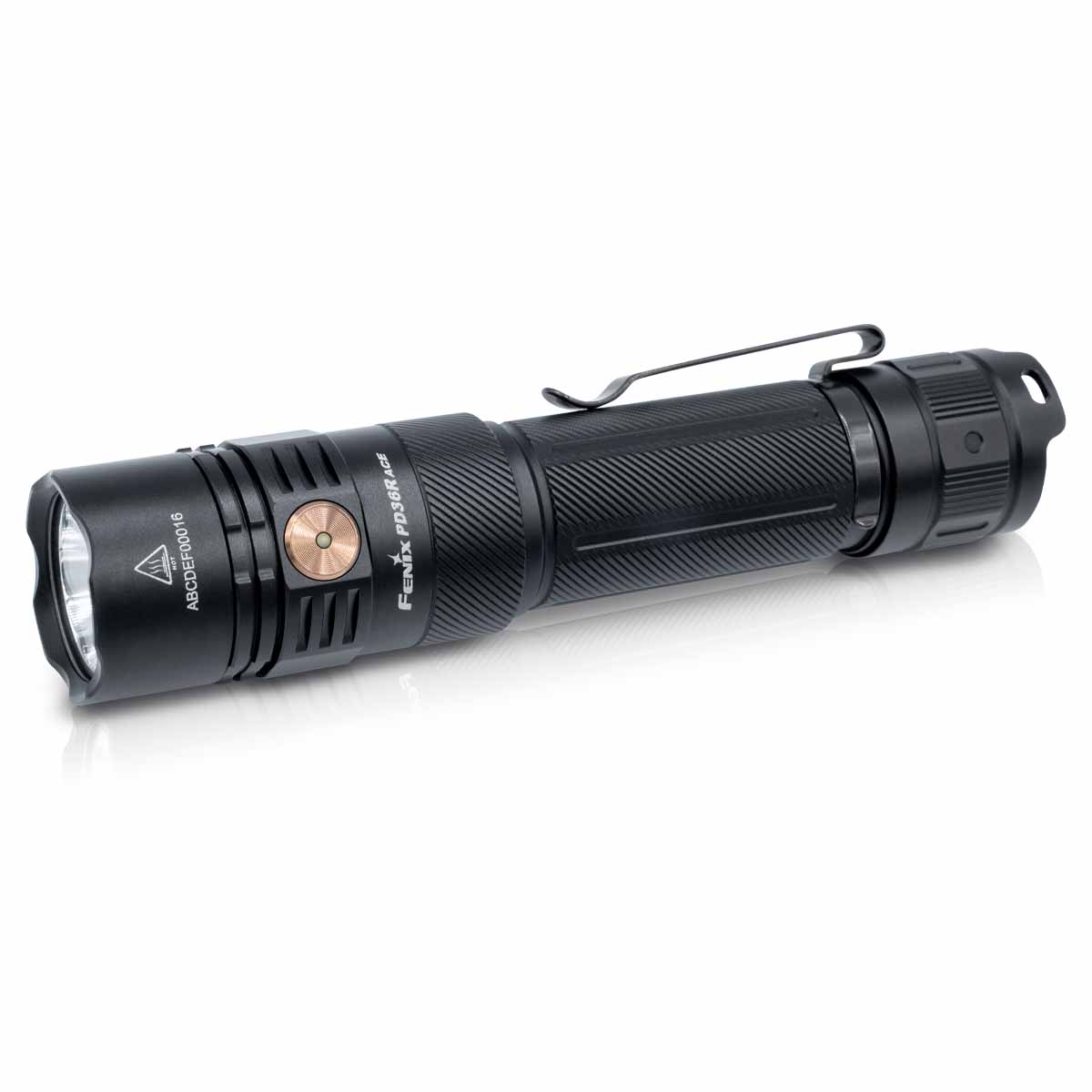
The Fenix PD36R ACE sits squarely in that middle category: a removable 21700 cell you charge over USB-C without taking it out, so day to day it behaves like a sealed light, but you can carry a spare for a long night and replace the cell when it eventually degrades: View on Amazon
Our recommendation: a light you use weekly should be rechargeable. A light that sits in a car or a drawer should take AAs.
3. Sustained Output, Not Peak#
This is the specification that separates honest manufacturers from the rest.
A small light cannot dissipate the heat of its maximum output for long. So a high-output compact light runs at the headline figure for somewhere between thirty seconds and two minutes, then steps down — often to a third or a quarter of the peak — and stays there. That lower figure is the brightness you actually use.
This is a property of output density, not of torches in general. A modest light has nothing to shed and no thermal cliff to fall off: the ProTac 2AA-X is rated at 270 lumens with a two and a half hour runtime on alkalines, fading gradually as the cells drain rather than dropping in the first minute. Step-down is the price of buying a big number in a small body.
Worth knowing about the number itself: the ANSI FL1 standard measures output thirty seconds after switch-on, which strips out the brief spike in the first few seconds and makes the figure comparable between brands. But it is a snapshot taken before the step-down, not after it. Sustained output is a separate number, and nothing obliges a manufacturer to publish it.
Manufacturers are not obliged to lead with this, and most do not. What to look for instead of the big number: a runtime graph or a stated output at a given time, usually described as sustained or regulated output.
The other half of the same question is what happens as the battery drains. A regulated light holds a steady brightness and then drops off near the end. An unregulated one dims continuously, so it is meaningfully dimmer at half charge than at full.
Our recommendation: compare lights on their sustained figure, not the turbo figure. If a manufacturer will not publish one, treat that as the answer.
4. The Interface, Which You Will Curse or Forget#
You use a torch in the dark, often one-handed, often while holding something else. The interface is therefore not a detail.
Three things are worth checking. How many clicks reach the mode you want — a light that starts on turbo and blinds you at 3am is as annoying as one that buries a useful mode behind a double-click. Whether strobe is in the main sequence, because a strobe you hit by accident is a genuine nuisance. And whether it has momentary-on, meaning a light press gives light only while held — the single most used feature on any tactical-style light, and the thing you miss immediately when it is absent.
Mode memory is the last piece: does it return to the mode you last used, or always start from the same one? Neither is wrong, but only one matches how you work.
Our recommendation: if the light will be used mostly at night in short bursts, prioritise momentary-on and a low first mode over any amount of extra output. Interface matters most on duty-style lights, where the mode you reach first can matter a great deal — we compare that class in tactical flashlights for everyday defence.
5. Size, Clip and Whether It Actually Gets Carried#
The best light is the one in your pocket, and pocket carry is decided by details that never make the spec sheet.
Weight matters more than length. A long, light torch disappears in a pocket; a short, dense one pulls at it all day and gets left at home by the end of the week.
The clip decides whether it rides high enough to grab quickly, whether it can go on a cap brim, and whether it survives being caught on a car door. A weak or badly placed clip is the most common reason an otherwise good light stops being carried.
Tail stand — whether the light can stand upright on its base — turns any torch into a lamp for a room or a work area, and costs nothing when it is designed in.
There is also the option of removing the carry question entirely. A keychain light lives on the keys you already carry, so the honest comparison is not against a bigger torch but against having no light at all. The Nitecore TIP3 puts 720 lumens on a keyring — a turbo you can reach directly when you need it, and five brightness levels stretching the built-in cell as far as 160 hours, which is the honest way to read any keychain light: View on Amazon
Our recommendation: be honest about which pocket it will live in, then weigh the candidates. Carry rate beats every other specification. If daily pocket carry is the whole point, start from the lights built for it in EDC flashlights for pocket carry.
Three Lights, Three Different Answers#
None is better in the abstract; they resolve the decisions differently.
The Fenix PD36R ACE is the output answer: 3,000 lumens from a duty-sized body on a removable 21700 cell, with a SET mode that lets you decide which modes the switch cycles through. It is also the heaviest here at 182g against the Streamlight's 99g — by this page's own weight-first rule that is the trade you are making for the brightness: View on Amazon
The Streamlight ProTac 2AA-X is the multi-fuel answer: designed to run on more than one cell type, so it can live on cheap AAs in a glovebox or take Streamlight's own lithium-ion pack when you want more output. If the light must work after six months in a drawer, this is the shape that solves it: View on Amazon
The Nitecore TIP3 is the always-there answer. It is a keychain light, so it wins the only specification that beats all the others — being present — and it does it without asking you to change what you carry. See how it stacks up against bigger lights in our best EDC flashlights comparison: View on Amazon
How to Choose in Five Minutes#
Start with distance. If everything you light is within arm's reach, buy flood and stop reading throw numbers.
Then decide where it lives. Daily pocket carry means rechargeable; a glovebox or an emergency drawer means AA, because a charge level fades on its own and a cell in its packet does not.
Then find the sustained output, not the peak. If it is not published, assume the worst — that is usually why it is missing.
Then check for momentary-on and how many presses reach a low mode, because that is what you will interact with every single time.
Finally weigh it and look at the clip, because a light you stop carrying has no specifications worth discussing.
If the answer came out "one light, charged by USB-C, bright enough that I never wonder" — and you can live with 182g in the pocket — the Fenix PD36R ACE is the one that clears it: View on Amazon